
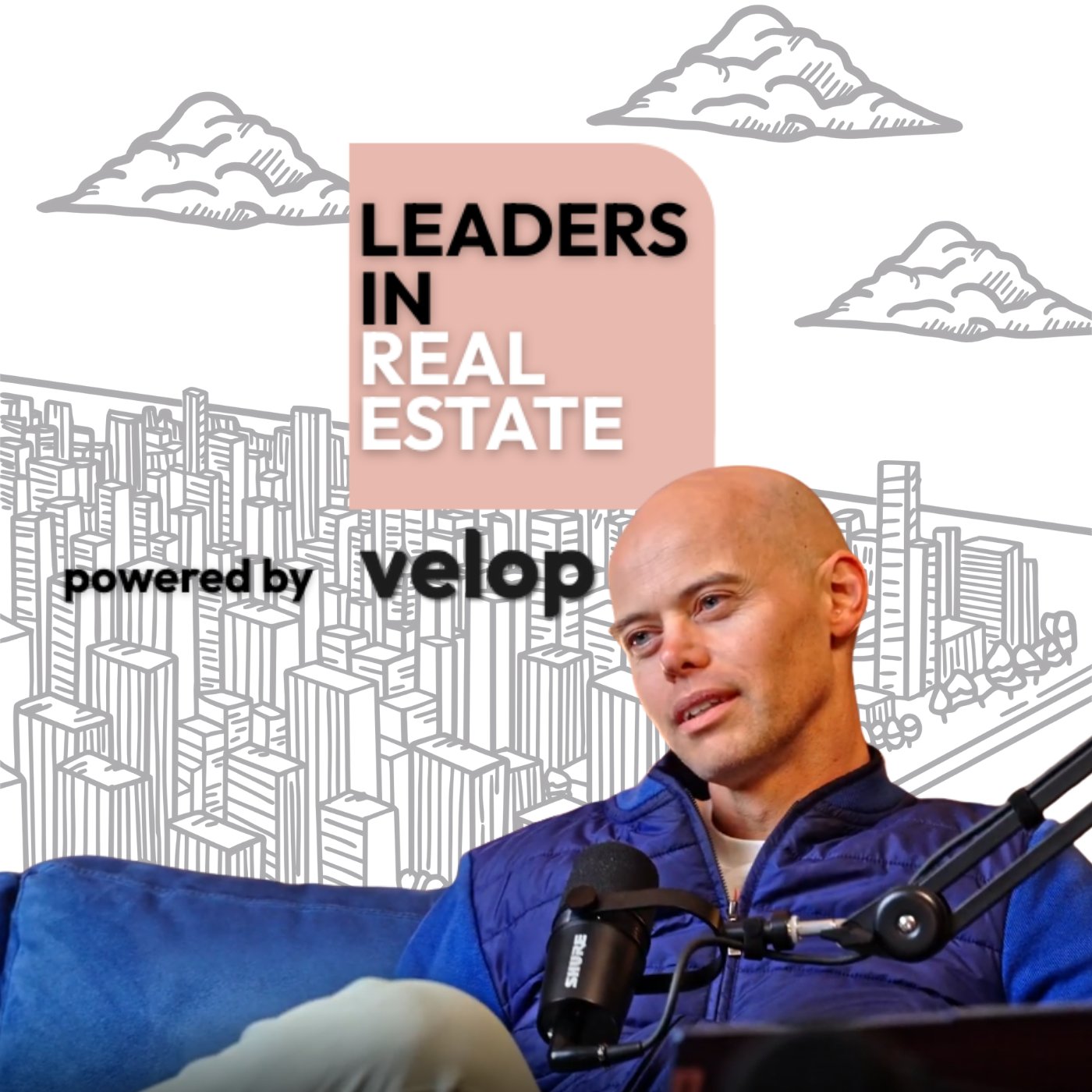
In this episode of Leaders in Real Estate, Velop founder Nick Carman talks to Dave Martin, President of Swire Properties USA, about 30 years in real estate across Hong Kong, Singapore, New York and Miami. Dave explains how eight months at Westfield became his most valuable lesson, how he stays calm under pressure, and what he looks for in every hire.
Key takeaways
- Treat every new market as a foreign posting, even when everyone speaks English. Dave assumed New York would work like Asia and lasted eight months at Westfield.
- A setback can be paid tuition. The relationships Dave built in New York later helped him reposition the mall at Brickell City Centre.
- Leaders take on stress instead of passing it down. Dave says you owe it to your colleagues not to transfer it.
- Talk to every level of the business. Frontline teams, like the loading dock, spot problems three layers of management before you do.
- Expect the year-three itch. A new role takes about a year to master, and by year three or four you start looking at what's next.
- Hire for ownership: someone who will "give the wins to the team and take the losses personally."
- If you feel overlooked, be in the office, volunteer, and say yes.
About Dave Martin
Dave Martin is President of Swire Properties USA, the Miami-based US business of Hong Kong-listed Swire Properties, which has shaped the Brickell neighborhood since 1979 with Brickell Key and Brickell City Centre and is now developing The Residences at Mandarin Oriental, Miami. An Oxford graduate, Dave began his career teaching English in Harbin, China, then spent around 30 years in leasing, asset management and development across Hong Kong, Singapore, New York and Miami. Along the way he ran a luxury retail repositioning in Bangkok with LVMH at 25, managed a major Hong Kong office tower through SARS and led retail at Westfield World Trade Center. He joined Swire to run retail at Brickell City Centre before stepping up to President.
In this episode
- 00:00 "Eight months on my resume"
- 00:20 Introducing Dave Martin, President, Swire Properties USA
- 01:12 Swire in Miami and The Residences at Mandarin Oriental
- 03:00 First taste of leadership: Bangkok at 25 with LVMH
- 06:26 "Did you feel ready?"
- 07:07 Why moving countries (even to the US) means starting from scratch
- 09:04 What drove him: leaving the UK and the three-year itch
- 13:57 Calm under pressure and not transferring stress
- 17:09 Building bonds from the loading dock to the boardroom
- 20:43 Failing at Westfield
- 24:18 How to shake off a setback
- 25:48 Rapid fire: the number one trait he hires for
- 27:37 School taught me to lead, Oxford taught me to think
- 28:47 Feeling overlooked? Be present and volunteer
- 31:03 Wrap
Questions answered in this episode
What does Dave Martin look for when hiring?
Responsibility above all. His number one trait is "somebody who's gonna take responsibility and lead their team, and give the wins to the team and take the losses personally." It describes how someone behaves when things go well and when they go badly, not a credential.
Why did Dave Martin leave Westfield after eight months?
After 20 years of success in Asia, he walked into New York expecting to win and assumed the same language meant the same market. It didn't work. "I wasn't fired. I was probably gonna get fired fairly quickly." He left rather than wait, and calls the experience paid tuition.
How should you handle a career setback?
Dave's advice is practical: if you can see you're not adding value, don't hang on until someone else makes the decision. "In the US, everybody's been fired." Take what you learned with you. His New York relationships later helped him reposition the mall at Brickell City Centre.
What should you do if you feel overlooked at work?
Be in the office, because "you're not gonna get these opportunities remotely." Volunteer, and if someone asks for your help, say yes. Don't stay quiet all year and then raise it in your review.
How long should you stay in a role?
Dave says a new role takes about a year to become truly effective. By year three or four it's natural to start looking at what's next, which is how he kept his own career moving while staying loyal to his employers.
Notable quotes
"It's eight months on my resume, which is how long I lasted there... If I'd succeeded, I'd still be there." (21:05)
"You owe it to your colleagues to do your best not to transfer stress." (14:40)
"Make sure you're in the office... You're not gonna get these opportunities remotely." (29:12)
About the host and Velop
Leaders in Real Estate is hosted by Nick Carman, founder of Velop, a real estate executive search firm for investors and developers in the US. Velop uses personality and cognitive assessments at the start of every search so clients can judge culture fit and potential before the shortlist. Contact Velop
Full transcript
[00:00] Cold open: “Eight months on my resume”
Dave: I wandered into New York having done 20 years in Asia and been successful there, so naturally enough, I expected success. I worked for Westfield for a year in New York. It’s eight months on my resume, which is how long I lasted. That was a huge challenge that I failed at.
[00:20] Introducing Dave Martin, President, Swire Properties USA
Nick: Welcome to the Leaders in Real Estate podcast. I’m your host, Nick Carman, and today I’m joined by Dave Martin, President of Swire Properties USA, the Miami business of the Hong Kong-listed developer that has shaped Brickell since 1979.
Dave’s career began teaching English in Harbin, China, straight out of Oxford. Since then he’s spent 30 years leading leasing, asset management and development across Singapore, Hong Kong, New York and now Miami, from Marina Bay Financial Centre to Westfield World Trade Center. You joined Swire in 2018 to run the retail element of Brickell City Centre, and this year stepped up to the number one spot as President, responsible for leading the Residences at Mandarin Oriental, which I believe broke ground just this month, right?
Dave: That’s right. Two weeks ago.
[01:12] Swire in Miami and the Residences at Mandarin Oriental
Nick: So, Dave, tell us a little more about your role today.
Dave: Sure. I’m President of Swire Properties USA. As you mentioned, Swire Properties has been here in Miami since the late ’70s. We’re solely focused on the city of Miami. In fact, over that time we’ve never really extended ourselves beyond the Brickell neighborhood. We developed Brickell Key over 40 years: the various condos, the Mandarin Oriental hotel and a commercial building. Most recently, about 10 years ago, we completed Brickell City Centre, a five-million-square-foot mixed-use project right in the middle of the Brickell downtown district. My responsibilities cover all aspects of this business.
As you mentioned, we’re part of a larger listed real estate company with the majority of its assets in Asia, particularly mainland China, Hong Kong and Southeast Asia. The business here is solely focused on one development right now: the Residences at Mandarin Oriental, Miami, on Brickell Key, a redevelopment of the old Mandarin hotel. We’re bringing that back, and we’ll get onto more of that soon. As President, I’m responsible for the overall success of the development. We’ve just broken ground, so our focus right now is construction on site, ongoing pre-sales of the condos, and planning for the Mandarin hotel, which is coming back as part of the development.
[03:00] First taste of leadership: Bangkok at 25 with LVMH
Nick: Let’s wind the clock back a little. The people tuning in are fast approaching their first experience of leadership, and they’re looking for inspiration. So if we go back, Dave, when did you first get a taste of leadership?
Dave: My first real leadership role would have been around 2000. I’d probably been with the company a couple of years, learning sales and particularly leasing, which was my focus at the time. I went down to Bangkok, in Thailand, where Hongkong Land had invested in a shopping mall.
This was a time when the luxury goods groups, particularly LVMH and Gucci Group, as it was then, as well as Richemont, the watch-focused luxury group, were buying back their franchises in Asia. They’d realized how much revenue these luxury brands were generating in Asia, and in the ’80s and ’90s it had generally been handled by local franchisees. The luxury groups wanted more control and more margin, so they were buying back the franchises and putting more capital into the real estate and the stores. That was something we were starting to explore in Hong Kong, and we used this project in Thailand almost as a test case, partnering with LVMH.
They brought five or six key brands. We renovated the mall and created a number of flagship stores for those brands. I was asked to lead that effort, although I was being fairly closely monitored. I was the Hongkong Land representative on that investment, if you like, and I was probably about 25. While it wasn’t a huge investment, it was very high profile, so that was really my first true leadership role on the corporate side.
These were fairly early steps into the flagship store model, so all the senior management from the brands came out and visited regularly, and I was interacting with them. We had a great local partner who guided me through Thailand. It worked because everybody knew their role. It goes without saying that’s a key part of building a team, but plenty of times you don’t get it, and there’s confusion, to a greater or lesser extent, about what people’s roles are. This was very clear. It was well set up, and everybody was good at what they were doing and capable. We were a little late with the project, but in the context of that market, I think it created a new benchmark for luxury in Bangkok.
Just as importantly, arguably more importantly for Hongkong Land, I think it demonstrated on a small scale what was possible through partnership between the developers, landlords and owners, and the brands. That’s still going on in Hong Kong today, with Hongkong Land and with Swire.
[06:26] “Did you feel ready?”
Nick: Did you feel ready?
Dave: At that age, I probably didn’t stop to question myself. You’re 25 years old, someone asks you to go to Bangkok and run a business, and you say, “Sure. Sounds great. Let’s go.” But my boss at the time knew when it was appropriate to get heavily involved and when it was appropriate to back off and let me do my thing. I think everybody who worked for him would agree. He wasn’t letting you do whatever you wanted, but at the same time he wasn’t in your ear every five minutes, checking and getting in the way.
[07:07] Why moving countries (even to the US) means starting from scratch
Nick: You’ve had such a wonderful career, Dave, particularly because of where you’ve chosen to do it. It’s so varied, across so many different cultures. How has that prepared you for your role today?
Dave: When you’re moved around different Asian countries in these roles, it’s very obvious that you have to take a moment to try to understand the local culture, particularly as it relates to work and business practice. You have to be sensitive to, and knowledgeable about, who’s who and how things work.
I think there’s a temptation for an English speaker, a Caucasian such as myself, to come to the US in general, and maybe Miami in particular, and assume that because the language is the same, “Okay, I’ve got this. I don’t need to be so sensitive or knowledgeable, because everybody’s speaking English.” But New York is its own animal in every sense, versus Miami, versus Chicago, versus LA. The attitudes, the working practices and how you get things done are very different.
Ultimately, what are we trying to do? We’re trying to be effective in a leadership role, a management role, a developer role. So how am I going to be most effective? Where are my gaps in knowledge? Where do I need help? And where do I feel strongly that I can add value from my own toolkit of experience? Moving into this role, there’s a huge amount I need assistance with. But there are also other things where I feel I can do this, and do it effectively.
[09:04] What drove him: leaving the UK and the three-year itch
Nick: I want to stay in those early chapters, Dave, and tap into what drove you, because you had this taste of leadership really early on, with lots of responsibility. What was driving you?
Dave: That’s a great question. There’s a temptation, especially looking back, when you know what the path was and where you ended up, to say it was, not necessarily preordained or fate, but that with hindsight, “Obviously I was going to do this.”
That said, if I go all the way back to why I left the UK… I’ve never worked in the UK. I left when I graduated and haven’t been back to work. I think it was a desire at the time to expand my horizons. It’s interesting: in the ’90s, global travel opened up to an extent that didn’t exist in, say, the ’80s. In the ’80s, the idea of getting a job in China… At one point in the ’90s I went by train from Moscow to Beijing. I wouldn’t make that journey now. So there was this decade when the world had really opened up, and you could visit, travel and work in these places far more easily than when I was 10 or 15 years old. Suddenly there were opportunities that hadn’t existed, and I wanted to experience them.
I also rationalized it. Whether it was that first decision to go to China for a year, or then to work in Hong Kong, I was consciously saying to myself, “If this doesn’t work out, I’ll come back. I’ll be 22 or 23 rather than 21, but I haven’t really lost anything. I’ll have some experience, and if I then need to slot in as a trainee solicitor, they’ll probably still take me.” I was conscious that I didn’t go and live on a beach for five years.
So that was probably the early decision. Then, during my nearly 20 years at Hongkong Land, I was very lucky, because it was a period of expansion for the company. You ask what drives me. I think there’s a pattern: if you start a new role, it takes about a year to become truly effective. Maybe a little less, maybe a little more, depending on the new role relative to your previous one. Then you’ve got a couple of years of being truly effective. And I’ve tended to find that at about year three or four, unless the role is giving you new challenges, you start to look, consciously or subconsciously, at what’s next.
For 20 years at Hongkong Land, the next thing was always within the company. Immediately after the Bangkok project, I went to run one of the major office buildings in Hong Kong for a couple of years. That coincided with SARS, a kind of precursor to COVID that hit Hong Kong particularly hard. It wasn’t a great experience, but it was one to go through, and it gave me very good perspective on managing during a crisis, which came back to us in 2020. I did that for a few years. Then there was an opportunity to go to Singapore for four years, and then to come back to Hong Kong and do retail, which I really enjoyed. Even within nine years of retail, we opened a project in Macau and planned and opened a project in Beijing. So if I were stuck in a role that wasn’t giving me satisfaction for more than three or four years, then purely from a personal-interest point of view, I’d be looking to move. That drives you to the next opportunity.
Nick: Understood.
Dave: It’s probably that internal voice: “I’ve been staring at the same floor plan for the last three or four years. I think it’s time to do something different.” Hopefully within the company. I’ve now worked for Swire for nearly 10 years, and I worked for Hongkong Land for 20. I don’t approach jobs wanting to move. My preference would always be new opportunities within the company.
[13:57] Calm under pressure and not transferring stress
Nick: Dave, I’ve been doing a bit of background research. I’ve been talking to a couple of your current and past colleagues, and one of the questions I asked them was, “What’s Dave great at?” Any idea what they might have said?
Dave: I have no clue. I’d be fascinated to hear.
Nick: The first thing that came up was “supremely calm under pressure.” They talked about one particularly complex project you’ve been involved in while in Miami. But I’d like to put it back to you. When did you feel most under pressure, and how do you keep your cool?
Dave: I think you owe it to your colleagues to do your best not to transfer stress. They need to understand that what they’re doing is important and needs focus. But I think the role of a leader is to absorb a lot, and translate it or give instructions appropriately, rather than simply transfer that stress.
Nick: I agree with you, it’s really important. But how do you do it? How do you not pass it on? How do you not come into a meeting, or leave one that hasn’t gone your way, raging?
Dave: I think naturally I’m relatively laid back, which can be good and bad. Where it translates into an ability not to get stressed and angry, I think that’s beneficial. Sometimes it can be less of an asset. But I don’t find it difficult, necessarily. It’s something I’m able to do. I can’t really explain it. I don’t have a life hack for it.
Nick: Understood. Out of curiosity, when I asked about the time you felt most under pressure, what was the first thing that came to mind?
Dave: Depending on which colleagues you asked, they’d probably talk about this one. We were closing a deal in 2025, so last year, where we sold the mall downstairs. Naturally enough, in the last week of an extremely complex transaction, things are always going to come up, and there were a few very stressful things that week. On one of them, I’m sure I was transferring the stress, and it was actually solved by another team member. Being a little further removed from the situation, they were able to say, “Why don’t we do this?” And everybody said, “Oh, yes, okay, we can do that. Go for it.” Five minutes later it was resolved. That’s the benefit of having the right people in the room and around the table, because if it had been left to me, I’d probably have made a much bigger deal of it than it needed to be.
[17:09] Building bonds from the loading dock to the boardroom
Nick: That’s a really nice segue into teams, because that was the next thing that came up about what Dave’s great at: getting teams, from the very top to the very bottom in seniority, all pulling in the right direction. Several people talked about how you build really great bonds with every level of an organization. That sounds great, and I’m sure we’d all like to do it. But why do you spend the time getting to know the people on the shop floor, quite literally in Brickell, for example, right through to the boardroom? How has that helped you?
Dave: I think there are two reasons. One, they’re often much closer to the business than you are. Certainly in an operating business, they’ll pick up on things more quickly. I’m not saying they’ll all give me feedback, although it sometimes happens. It’s great when you get that direct feedback: you bypass three layers of management, and the guy on the loading dock says, “We’ve got a real problem every morning at 11:00 AM, because we haven’t scheduled this properly.” So that’s one thing. You get that immediate feedback.
Going the other way, we’ve all been the junior guy, and in my mind, as leaders, don’t underestimate the motivation junior staff get from that interest and attention. I think that’s a Swire thing, and for that matter it was a Jardines thing: in all the institutions I’ve worked for, every employee is as important as the next. Everybody contributes to the success of the enterprise, and the motivation and sense of mission you can transfer through personal attention is real.
I’ll give you an example from Swire. The Swire Group has a number of businesses across the US. Some are privately held, some publicly held. We’re a public company, Cathay Pacific is a public company, and there are other private, family-office businesses. We have a golf day, which was two weeks ago, where you get to meet people from across all these businesses. I was talking with the CEO of one of the smaller businesses, and he was saying how amazed he was that the chairman in London had a very detailed knowledge of his business, which is relatively insignificant on the company’s balance sheet.
You could see the motivation he was getting from it. He was a CEO, but we’re talking about the chairman of the global business, so the gap, if you like, is similar to the one between me and the folks downstairs when we ran the mall. His company had just been acquired, brought into the group, and clearly he’d never had that experience before, where the owner’s owner was well versed in his business, interested, and wanted to talk about the problems and challenges he faced. You could tell he’d walked out of that meeting ready to put in the biggest year of his life, because he wanted to make a success of what he was doing. I think it’s the same in any situation like that.
[20:43] The Westfield failure
Nick: Now, Dave, a bit of insight into our audience. They’re a sadistic bunch. They love hearing when things have gone right, but they love hearing about the car crashes and the mistakes even more. Is there a mistake you feel you’ve learned the most from? One that’s been a really hard-learned lesson?
Dave: Look, I worked for Westfield for a year in New York. I think it’s eight months on my resume, which is how long I lasted, and then I left the business. That was a huge challenge that I failed at. If I’d succeeded, I’d still be there. Why wouldn’t I be in New York, succeeding in retail real estate? It was exactly what I’d done for the previous 20 years or so.
Naturally enough, when you fail at something, you want to learn from it. With hindsight, which I have the luxury of now, it was a few things. One, it went back to that culture issue. I wandered into New York having done 20 years in Asia and been successful there, so naturally enough I expected success. I realized fairly quickly that New York, from a business and cultural perspective, is very much its own animal. To give you an example, there are multiple brokers in New York who’ve made careers in retail real estate from knowing 10 square blocks. In SoHo, it might be five square blocks. But they know every single thing about the owners, landlords, leasers and tenants. That’s their territory, and you can’t tell them anything about it they don’t already know. That’s not unique to New York, but I think it’s particularly prevalent there.
There were the more general issues of coming into a new market and perhaps expecting an easier time. And I was on a very challenged project, the World Trade Center retail at the Oculus, which has always struggled. It struggled before I got there, and it’s struggled ever since, so maybe that was at least as much the project as it was me. But I got an amazing education in US and New York retail real estate. I understood very quickly how it was different, and I was getting paid. It was almost as if someone had said, “You’re moving to New York, and you need to learn how this works.” Perhaps you should pay for that knowledge transfer, and I got paid. That was the upside.
But objectively, I left the role after eight months. I wasn’t fired. I was probably going to get fired fairly quickly. It was fairly obvious. To its credit, Westfield is a company where people are either there for a year or for 20 years, so you find out pretty quickly whether it’s working, and it wasn’t. Again, that wasn’t unique to me. But objectively, it was a failure. Out of it I took a lot of education and a lot of perspective. Then I came down to Miami, did retail, and picked up a number of the relationships I’d started to develop. Ultimately we were able to do deals down here and reposition the mall, in no small part because of that year, or slightly less, of experience and challenge.
[24:18] How to shake off a setback
Nick: I think setbacks are inevitable in everyone’s career, big and small. And clearly you picked yourself up after that setback and went on to an epic win.
Dave: Yes. An epic win.
Nick: Any advice? How do you shake it off?
Dave: I think the first thing is, if you get to the point where you know you’re not adding value and you know the time is coming, you can hang on and get fired. Particularly in the US, everybody’s been fired, right? Here you get fired because you’re not the right fit or you’re not being effective, and I wasn’t being effective in that role. I think you can see it coming, and there’s probably a point where you can put yourself out of your misery and refresh.
I had a conversation with my father at the time. He could tell immediately the situation I was in, and he said, “You don’t have to continue doing this.” And this is one of the benefits of this country right now: we’re in an expanding economy. If you can’t find a job in Miami real estate, you probably need to be doing something completely different, because since COVID we’ve had an extraordinary expansion of Miami. That has fed through to all sorts of industries, and naturally enough real estate is a beneficiary and is very strong right now.
[25:48] Rapid fire: the number one trait he hires for
Nick: As we get into the final chapter, I want to get as much out of this session as I can, Dave. So let’s treat this as a bit of a machine-gun round, okay? What’s the number one trait you look for, or most admire, in the people you hire?
Dave: Somebody who’s going to take responsibility, lead their team, give the wins to the team and take the losses personally.
Nick: We talked about what drove you early on. Do the same things drive you today?
Dave: Yes. I love the variety of real estate. We’re in a profession where you’re looking at plans one day, spreadsheets and meetings the next. I love real estate as a profession because it has left-brain and right-brain aspects. And it’s a very social industry, in the sense that practitioners thrive on human connection, and nobody builds a building without a huge amount of collaboration. I love all of it.
Nick: Amazing. Let’s go back to the geography point. Where do you think has shaped you the most? Oxford, China, Singapore, Hong Kong, Miami? What’s had the biggest impact on you?
[27:37] School taught me to lead, Oxford taught me to think
Dave: I think growing up in the UK… it remains a very outward-looking place. We’re a small island of great institutions that I think do prepare you to think and to lead. My school probably taught me how to lead, and then Oxford taught me how to think, and I’ve carried those two things through all the geographies since. And my family taught me to respect other people. Everybody has a contribution to make. You’re not too important for anybody.
All of that is good, especially in real estate. With the most successful contractors, the chairman or the owner visits the sites daily, and people get motivated on the back of those visits. The most successful developers speak directly to their customers and make sure they understand what motivates the people who ultimately pay their salaries: your buyers, your clients, your shoppers. You have to be able to reach a very broad audience and synthesize everybody’s feedback.
[28:47] Feeling overlooked? Be present and volunteer
Nick: Before we wrap up, Dave, I want to ask you one last question. You mentioned that one of the traits you most admire in the people you hire and work with is the ability to take responsibility. If anyone in our audience is sitting there feeling they have more to give but aren’t being given the opportunity, what’s your advice?
Dave: Make sure you’re in the office. That wouldn’t have been something I’d have said 10 years ago, but you want to be present. You’re not going to get these opportunities remotely. I’d strongly advise that. Particularly in Miami, where we have long commutes, I feel a day from home each week is an appropriate and beneficial policy for an office, particularly for families, whether that’s working mothers or working fathers. I think it’s a good policy.
But I’d strongly encourage those who feel they’re being overlooked to volunteer, and the best way to volunteer is to be in the office, hear what’s going on and say, “I can do that.” Come with that enthusiasm. And certainly if you’re asked to do something, just say yes, as long as it’s not way out there or inappropriate, which it shouldn’t be. If it is, you need to get out of that company. But if somebody says, “Can you help with this?”, why would you say no if you’re in your 20s? You’ve got time. What are you trying to do? You’re trying to get experience. So don’t pull a face, and then a year later say in your review, “I think I’m being overlooked.” Yes, because you haven’t volunteered for anything. There should be plenty to do.
Come with a plan, come with a suggestion: “I know we’re building a hotel. I’d like your approval to go on a one-day course on how to manage a hotel, and come back and present to everybody.” Great. Or, “I notice we’re spending a lot of time on this. Do you need any help?” Chances are, whoever it is will say, “Yes, absolutely,” as long as it’s not interfering with whatever else you do. So just be present and volunteer.
[31:03] Wrap
Nick: Amazing, Dave. We’ve got to wrap this up. Thank you so much for giving up your time. I know our audience will really benefit from this and be educated and inspired in equal measure. Dave, thank you very much.
Dave: Great. It’s been a pleasure.
Published November 9, 2026. At the time of recording (October 2026), Dave Martin was President of Swire Properties USA.