
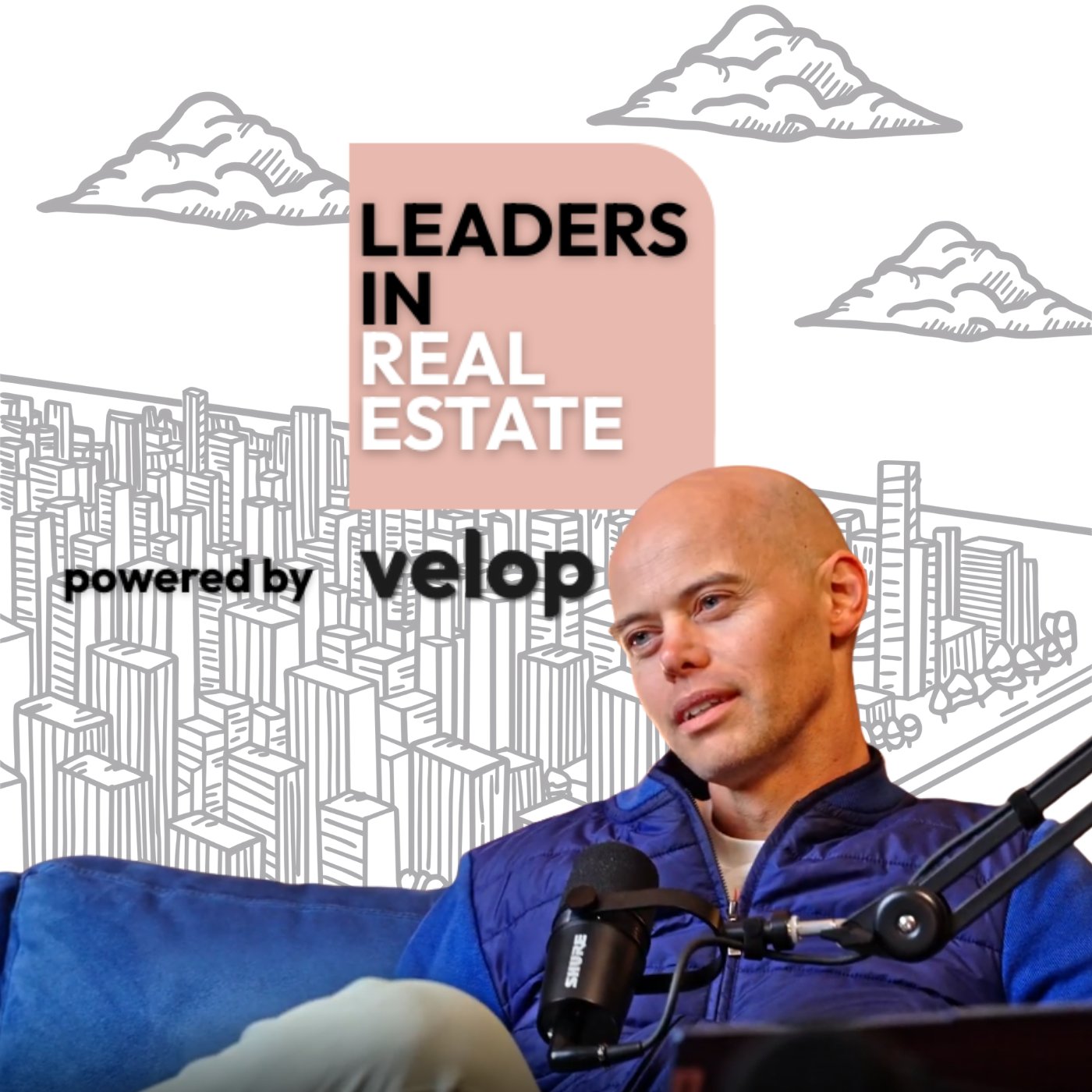
In this episode of Leaders in Real Estate, Velop founder Nick Carman talks to Daniel Lebensohn, co-founder of South Florida investment and development firm BH3. Daniel explains how he and Greg Freedman launched BH3 in the 2009 financial crisis, how persistence won their first deal with MSD Capital, and what rising leaders can learn from his setbacks.
Key takeaways
- Leadership is learned by observation. Daniel kept journals on the bosses he worked for, noting what he admired and what was missing, and used them to shape how he leads BH3.
- A no is a bridge to yes. After MSD Capital passed on BH3's first deal, Daniel asked them to send a second person, then bought a seat next to him on the flight to Miami.
- Tenacity is a muscle, not a gift. Daniel says he had to build the courage to use it, like training in a gym, and checks in on whether people and deals leave him "energized or drained."
- Put problems in the right category. He files most setbacks as "first world problems" so he keeps the bandwidth for the big ones.
- Partners show their true colors in adversity. A multi-year neighbor lawsuit over Privé at Island Estates cost an estimated $12 to $14 million to defend, and taught him that great partners are worth more than smooth deals.
- Don't waste energy on retribution. His JV partner Gary Cohen stayed gracious to the neighbors suing them, which taught Daniel to focus on goals, not grudges.
- In the age of AI, authenticity is the edge. As AI takes on analytical work, Daniel believes genuine relationships become the most valuable skill a young professional can build.
About Daniel Lebensohn
Daniel Lebensohn is co-founder and co-CEO of BH3, a South Florida real estate investment and development firm he launched with Greg Freedman in November 2009. A lawyer by training with a JD from New York Law School, he practiced law in New York for around a decade, spending the latter years also investing in distressed assets. BH3 has since invested billions of dollars across Florida and New York, including Privé at Island Estates in Aventura and Privé Malibu at Point Dume, California. Daniel leads the firm's deal sourcing, legal strategy and structuring. BH3 has a team of 35 across three offices, headquartered in Fort Lauderdale.
In this episode
- 00:00 Introducing Daniel Lebensohn, Co-Founder, BH3
- 01:48 Leadership as an evolution: learning by watching your bosses
- 02:51 Two founders, zero staff: launching BH3 in 2009
- 04:32 "A candy store on sale": opportunity in the financial crisis
- 06:02 No track record, no capital: cracking the first deal
- 06:57 His superpower: "A no is a bridge to yes"
- 07:43 Where his resilience comes from
- 10:08 Zero expectation, 10,000% aspiration
- 11:39 Tenacity is a muscle: the "energized or drained?" check-in
- 13:38 The JetBlue story: buying a stranger's seat to land MSD Capital
- 19:06 How BH3 got its name
- 21:24 Biggest setback: the Williams Island litigation
- 27:02 Don't waste energy on retribution
- 28:17 What BH3 looks for in a hire
- 29:43 The unpaid intern who got "paid to learn"
- 31:18 AI and why authenticity is your edge
- 33:42 Is leadership worth it? "This is not a dress rehearsal"
- 35:18 "I just want to get an A in life"
Questions answered in this episode
How did Daniel Lebensohn start BH3?
Daniel and Greg Freedman founded BH3 in November 2009, during the financial crisis, as a two-person firm where "every hat, every role" was theirs. Their first deal was a 117-unit distressed condominium at 60th and Collins in Miami Beach, bought at $84 a foot with backing from MSD Capital.
How did BH3 get its name?
During tough negotiations with MSD Capital, Daniel messaged Greg to ask whether the investors thought they were "baggage handlers." When they formed the deal LLC, he suggested "Baggage Handlers 3," one for each of the three partners on the deal. The name stuck.
How do you build tenacity?
Daniel says tenacity grows like a muscle: the first sessions are uncomfortable, and it gets stronger with use. His simple exercise is to check in after any meeting, event or deal and ask whether you feel energized or drained. If you leave a conference regretting an introduction you didn't make, remember that feeling and don't let it happen again.
What does Daniel Lebensohn look for when hiring?
Leadership skills and sincerity. His advice is to "marry intention with sincerity and authenticity." One of his key hires pursued him persistently, started as an unpaid intern for six months, and has since grown into a right-hand role across capital raising and asset management.
Is it worth taking the leap into leadership?
"Unequivocally." Daniel encourages people to gain experience and learn from others first, but warns not to wait too long: "Your mind will give you a hundred excuses... but take them. Take the risks."
Notable quotes
"A no to Daniel is just a bridge to yes." (said of Daniel by a colleague, 07:14)
"My expectation may be low. It may be zero, but my aspiration is 10,000%." (10:08)
"This is not a dress rehearsal. Last I checked, we get to go around once." (34:13)
About the host and Velop
Leaders in Real Estate is hosted by Nick Carman, founder of Velop, a real estate executive search firm for investors and developers in the US. Velop uses personality and cognitive assessments at the start of every search so clients can judge culture fit and potential before the shortlist. Contact Velop
Full transcript
[00:00] Introducing Daniel Lebensohn, Co-Founder, BH3
Nick: Welcome to the Leaders in Real Estate podcast. I’m your host, Nick Carman, and today we’ve got another cracker of an episode. This series is intended to boost your career and give you confidence in what I think is the biggest step change in anyone’s career: leaving the solo operator role for a leadership role. I very much hope we get to explore that with our guest today.
Daniel Lebensohn is co-founder and co-CEO of BH3, the South Florida real estate investment and development firm. He and his partners launched it in 2009, right in the doldrums of the financial crisis. Daniel’s a lawyer by training, with a JD from New York Law School and more than a decade practicing in New York. He built his early career acquiring and turning around distressed assets before scaling BH3 into a national player, with billions of dollars invested across Florida and New York, from the twin towers of Privé at Island Estates in Aventura to Manhattan. Today he leads the firm’s deal sourcing, legal strategy and structuring. Daniel, how are you doing today?
Daniel: Very good. Good to be here, I appreciate it. Good to connect with you.
Nick: I’m really glad you’re making the time. Let’s jump in. This is a podcast aimed at rising stars and future leaders. I think of them as on the precipice of taking the next big step in their career, looking down the barrel of leadership for the first time.
[01:48] Leadership as an evolution: learning by watching your bosses
Nick: Do you remember your first leadership role, and what your experience of it was?
Daniel: For me, it was an evolution, starting with my legal career. I wasn’t always in a leadership role, and I don’t think most people are. It evolves over time, through a lot of different events and experiences, if you’re paying attention. My leadership developed through observation. I watched the people I worked for, both as a lawyer and as an entrepreneur, and made mental notes, and sometimes physical notes. I kept journals of what I admired in their leadership and what I thought was missing. Over time, that notched chips in the wood and helped me shape my ideology of how I wanted to run my company one day, and how I would lead and work with people.
[02:51] Two founders, zero staff: launching BH3 in 2009
Nick: Given that first step you’ve just described, Daniel, how ready did you feel?
Daniel: Every day presents challenges when you’re leading, even a small shop. Don’t forget, my co-founder Greg Freedman and I started the company in November 2009. We were the staff. There was nobody else, just two leaders in the room, and it evolved from there. At that time it was interesting, because we both definitely had alpha instincts, and we had to learn to lead alongside a fellow leader. That’s part of the DNA of the firm. You have a lot of smart voices, so you have to collaborate, listen well and engage. You have to be able to be candid about your thoughts, but also value and consider your peers.
So we started with just a few people. As it evolves, you start to have team members looking for guidance and leadership, looking for people who own the direction of a deal and the direction of the firm, which has evolved quite a bit over the last 18-plus years. But the beginning was two leaders working through a lot of different issues, where every hat and every role in the company was ours to own and execute.
[04:32] “A candy store on sale”: opportunity in the financial crisis
Nick: And what were the biggest challenges for you in that chapter of your career?
Daniel: It was the great financial crisis. I had fully transitioned out of practicing law a couple of years earlier. When the GFC hit, it was like someone opened a candy store for me and said, “Go inside and pick out what you want. It’s all on sale.” It was a really exciting moment. I really had that picture in my head, because the banks were scrambling. A lot of the big players were dealing with issues, because if you had a lot of deals ongoing at that time, no matter how bright you were or how great your firm was, you had problems. If you’re taking risks, there are times when you have to deal with the downside. Over those few years, anyone doing anything in real estate had a lot of wounds to lick and address. So for us it was a unique moment. Thankfully, a mutual friend had introduced Greg and me some time before that, and it was very organic. When I met him, I knew he was meant to be a partner and friend of mine, which is exactly what he’s become.
[06:02] No track record, no capital: cracking the first deal
Daniel: During that period, the biggest challenge was raising capital. There were a lot of stalled deals, and a lot of private equity investors, high-net-worth investors and multifamily offices didn’t want to put money out, because there was a lot of fear in the air. On top of that, we had no track record. I’d done a handful of multifamily deals in the Northeast, and Greg had done quite a bit of lending origination, but we didn’t have a material track record that the capital sources we needed would recognize. So we did what I do: we fought, we didn’t take no lightly, and we pushed very hard and aggressively until we got the capital we needed to crack the can and do our first deal in Miami.
[06:57] His superpower: “A no is a bridge to yes”
Nick: That’s a nice segue, Daniel, because on this pod we like to do our research. I’ve had a chance to talk to a couple of people who know you pretty well, and I asked one of them, “What’s Daniel’s superpower?” To be fair, he said it was really difficult to narrow it down to one, but the standout is tenacity. “A no to Daniel is just a bridge to yes, and the guy just does not know quit.” That’s a really enviable trait, so I want to unpack it a little.
[07:43] Where his resilience comes from
Nick: Where does that come from?
Daniel: First of all, I’m flattered to hear that. It sounds like one of those game shows where you phone a friend. But a lot of the credit is due to my father and my mom. They were amazing role models, and they were as resilient as they come. My dad’s still with us. I never saw anything shake him or throw him off balance, no matter what the challenge. I think that has to do with his upbringing. He grew up without much of a childhood, as a young child in Europe during World War II. He was literally running for his life a lot of the time. After a series of years in Austria and then Hungary, he eventually escaped to Israel. He saw things that humans shouldn’t see and shouldn’t experience, so everything else was really nothing to him.
I know that’s part of my DNA: putting things in their correct category. I categorize a lot of things in life as first-world problems. If something goes in that category, I make a point of not giving it undue attention or negative thinking. I’m just grateful for the moment and recognize those as small problems. Then, when the big problems come, I have the brain power, the bandwidth and the capacity to address them.
Knowing who I am, I don’t want to miss out on having the conversation. Whether it’s Elon Musk, the president of the United States, or the owner of a building I’m trying to get to, as long as I make a valiant effort to really go after it with heartfelt passion, I’m content, regardless of the outcome.
[10:08] Zero expectation, 10,000% aspiration
Daniel: My expectation may be low. It may be zero. But my aspiration is 10,000%. That’s important to me. I just keep going at it. Obviously, I’m looking for the yes. I’m looking for the win. I want to accomplish whatever the goal or purpose is. If I don’t go after it, that’s 1,000% on me, because it could never have happened. But if I do go after it, that may be 10 times or 100 times. My executive assistant knows there are certain people she contacts for me every month, some of them going on five years. I’ll keep going until I get a no, or a yes and an engagement, because at the end of the day, persistence matters most of all.
Nick: I’d like to pick you up on something there. We’ve talked about tenacity, not knowing how to quit, never giving up. But there’s another side to tenacity. If someone doesn’t have the drive to complement it, their ceiling is much lower. Your drive is clearly sky-high. We know that from what’s happened over the 20 years BH3 has been around. So what drove you in those earliest days?
[11:39] Tenacity is a muscle: the “energized or drained?” check-in
Daniel: Knowing who this podcast is for, I think it’s important to recognize that just because I have that tenacity doesn’t mean I’ve always had it, or that I didn’t need to build the courage to bring it to the surface and use it. It grows. It’s like exercising a muscle. The first day in the gym isn’t fun, and the days after are even less fun because you’re sore and tired and don’t want to go back. But the more you go, the stronger you get. It’s about exercising muscles, mental, physical and emotional, and working toward that. These things build up over time.
I do a very simple exercise that I’ve shared with my two daughters over and over again: check in with yourself. Whatever you’re doing, say you spend an evening with someone. Afterward, how do you feel? Better or worse? Energized or drained? Going after a deal: energized or drained? It’s a great tell for how things are going to go, and for figuring out how to make the best use of your time and spend it with people who contribute to your growth and fulfillment.
I say that in the context of your question because if you were at a conference and didn’t go up to that person, didn’t go after that meeting, didn’t introduce yourself, and you don’t feel great about it afterward, remember how you felt and don’t let it happen again. Just go after it. The worst case is they say no. First-world problem. They said no to you? Great. It’s literally the bridge to yes. It’s one step closer. And maybe they’ll say, “What you’re telling me isn’t for me, but I know someone it’s right for. You should talk to them.” Just keep pushing.
[13:38] The JetBlue story: buying a stranger’s seat to land MSD Capital
Nick: Someone told me a story about just how creative you are about getting to that yes. They told me about you booking a flight ticket. Do you mind sharing it with our audience?
Daniel: Sure, I’m happy to. It’s a fun story. That was the first deal Greg and I did in Miami. We were going after a 117-unit busted condominium at 60th and Collins. Like I said, the market was dead. No one wanted to touch Miami. The news was predicting 10 or 15 years of condo inventory. Neither of us had ever done a condominium project, but we both had an appetite, and he was tenacious and resilient too.
We were looking for capital. Funny thing is, we were still living in different states. I was in New York, about to move down. He called me one day and said, “Daniel, we’re working on this great deal together. Do you have the capital?” And I said, “I’m heading in the right direction,” but I’m not one to make things up, so I told him I didn’t actually have it locked down yet. He said, “How do you feel about bringing in a friend of mine who’s connected to a few private equity shops?” I said, “Absolutely. The goal is to get the deal done. We don’t need to grab every last dollar. We want to build a reputation and get deals done.”
So he introduced me to Charlie, now a longtime friend of ours, and we went after MSD Capital, Michael Dell’s family office. At that time it was really just Michael Dell’s money. Today it’s a very large institutional investment firm with some of the best and brightest in the world running different strategies and platforms.
Long story short, we convinced them to get on a plane. They sent someone down, a lovely guy, but what I’d call a bean counter. There’s nothing wrong with being a bean counter, but you have to put the right dish in front of the right person. If you put a cheesecake in front of a health fanatic, they’re probably not going to eat it, unless no one’s looking. He came down, they did the analysis, and they said, “Thanks, but no thanks.”
We were scratching our heads. Two hundred thousand feet of net sellable space across the street from Miami Beach. They’re not making any more land, certainly not on the beach. Unacceptable answer: bridge to a yes. So we pushed them: “Can you send someone else down, someone with a different perspective? We’re buying this for $84 a foot. You can’t even buy the land for $84 a foot.”
Sure enough, they agreed. I forget exactly how, but I figured out which plane this guy, Matt, was going to be on. Matt has become a friend of almost two decades. It was a JetBlue flight out of New York. I got on the same plane, got there very early, and tracked down his seat. I hadn’t been able to get the seat next to him in advance, so I went over, introduced myself and sat down next to him.
Then a woman from the Bronx came over and said, “Hey, papi, that’s my seat.” I’m pretty polite. My mom gave me good manners. I put my hands up and said, “Listen, I need to sit next to my friend. I have to talk to him.” She was looking at me with some attitude, and she could easily have asked me to move. So I said, “It would be my honor. I’ll buy your ticket. I just need to sit here.” I approached it softly. I didn’t insist on anything, but I kind of did. She smiled, said, “Don’t worry about it,” and took my seat.
Meanwhile, this guy’s looking at me like I have three heads, because he’s never met me. I’d only spoken to him on the phone. And sure enough, we got stuck on the tarmac. So now I had the bonus round: almost two hours on the tarmac with Matt, plus two and a half hours in the air. He wasn’t escaping. I had four and a half hours, plus the walk out of the airport. Suddenly I had five hours with a captive audience who had a very big checkbook, and I used it. I warmed the waters, then we landed and Greg did his magic. Greg is a finance wizard. We took Matt to the property and to the comps, with Charlie as well. It worked out, and we got the deal done with them. That deal is also how our company got its name, which is another fun story.
[19:06] How BH3 got its name
Nick: This is the BH in the name?
Daniel: Yes, that’s the story. The short version is that while we were negotiating, they wanted to do the deal, but they wanted us to work for McDonald’s wages. As much as I used to love eating McDonald’s years ago, I don’t want to be paid McDonald’s wages. I don’t think anyone does.
We were negotiating over GoToMyPC, which at the time was a way for everyone to look at the same screen from different computers. Greg was in his office in Fort Lauderdale, I was in New York, and Matt and his team were in a separate office in New York. They offered us terms that were, let’s say, less than appealing. So I wrote an instant message to Greg. Am I allowed to curse on this podcast? I literally wrote, “[Expletive] these guys. I’m not working for free. What do they think we are, baggage handlers?”
Greg started blowing up my phone: “They can see the screen! Everyone’s on the same screen!” He was having a heart attack in Florida, and I was saying I didn’t care. Long story short, we got a slightly better deal. When we were organizing and had to form an LLC, Greg asked, “What do you want to call it?” I said, “Why don’t we call it Baggage Handlers 3?” At the time, Greg, Charlie and I were the three baggage handlers. And MSD didn’t know why we’d named it that until a long time afterward. So that’s the name.
It really suits us, because we did anything and everything. There were gardens on that property, and one of us watered them every day. We did whatever it took to finish the project cost-effectively and efficiently. We didn’t have much of a team.
[21:24] Biggest setback: the Williams Island litigation
Nick: We’ve talked a lot about the early days, setting up BH3, and this superpower of tenacity and drive. Thinking about what our audience can learn from you, I’m a big believer that we learn more from our failures than our successes. What’s been one of your biggest setbacks, and what did it teach you?
Daniel: The fact is, if you’re taking risks, there are going to be failed deals and hurdles to overcome. You may not go in thinking that, because you need to be an optimist, particularly in real estate, and I believe that applies to all businesses. But you have to anticipate shortcomings and things you didn’t expect. We’ve seen that over the years. We traffic in distress. We like distressed assets, so we’re often uncovering and deconstructing complex situations.
The best example is the two-tower project we built on an island in North Miami that you mentioned, Privé. By the way, we’re now doing Privé Malibu. We just launched a magnificent project at Point Dume in Malibu, California, which also calls for that kind of responsiveness to situations. On Privé, we did a joint venture with an amazing family, the Cohen family, and a man named Gary Cohen, whom I’ve learned a lot from over the years. We signed a deal with him within two weeks. We knew the property was magic.
Not long afterward, maybe another two or three weeks, the neighbors, two and a half thousand well-to-do condominium owners in 13 buildings, with one master association and 13 HOAs on Williams Island, which is really a peninsula, not an island, decided they were going to sue us and block any possibility of developing the site, which absolutely had the rights.
Gary came to us, an honorable, old-school guy, with the JV paper in hand, and said, “Listen, guys, I didn’t expect this. The rights are there. They’re as solid as concrete and strong as oak. What I want to do is rip up this paper, and when I’ve finished the litigation, I’ll come back and we’ll do the deal together.” Call us crazy, but we looked at him and said, “Gary, I don’t think you know us well enough. We’re not going anywhere. We’ll fight this fight. We’ve done our homework, the rights are there, and we want to do this project with you.” And that’s exactly what we did.
Imagine going into a deal thinking it’s smooth sailing, that you’re going to build this magnificent, one-of-a-kind project, which went on to win an award in 2017, I believe, for the most luxurious condominium living in the world. I pinch myself saying that, because it’s way beyond what I dreamed of as a younger man. But we did it through smoke and fire. Then another group of neighbors filed a separate lawsuit, and it became a multi-year battle that cost us roughly $12 to $14 million in litigation to beat them back and ultimately win.
And keep in mind, you’re trying to sell something beautiful and singular, multi-million-dollar condominiums, while there’s noise in the press about litigation and entitlements, and agents and buyers are asking, “Is this ever going to get built?” So we really had to sell the project twice, through severe adversity, and have many difficult conversations, not only with agents and their clients but with our investors.
I learned a lot through that. First of all, there’s nothing more potent than great partners who rise to the occasion in adversity. Everyone’s great when things are going beautifully. When there’s an issue, or a whole host of issues, as there was there, you see everyone’s true colors. Greg, Gary and I had heated moments, but we were all rowing in the same direction. It was all about how we resolve this, get to the next issue and check it off the list. It was an extraordinary experience.
[27:02] Don’t waste energy on retribution
Daniel: I learned a lot from Gary. Some neighbors were doing some very nefarious things to disrupt our construction, right down to destroying a sidewalk we’d built by driving over it in the middle of the night in their fancy cars. Even through all of that, Gary was always a gentleman. He was always nice to them. He went out of his way to be nice to them. They needed parking while construction was going on at their homes, and these were people suing us and literally disrupting us, yet he let them park on a separate piece of his land.
That was an aha moment for me, watching a man some years older than us. It taught me not to waste energy being angry and not to waste energy seeking retribution. Focus on your goals, and don’t let anyone squander your time and brain power on negative engagement. It’s not helpful. If someone is that bad, they’ll find their own trouble without your help. Why let them steal your time?
[28:17] What BH3 looks for in a hire
Nick: As we enter our third and final chapter, Daniel, I want us to talk directly to our audience and give them some advice. When you’re hiring for BH3, what are you looking for? What traits do you want to measure?
Daniel: First of all, I’m admittedly probably the worst person to interview anyone, because I end up being exuberant about how wonderful BH3 is, what a great team we have, and how our company is really a family. We’re a family of 35. Everyone wants to be compensated according to their skills and seasoning, of course, but I’d venture that most people here are just as rewarded by the fact that it’s a very collegial, warm environment. We have three offices, and at our headquarters in Fort Lauderdale everyone eats together, spends time together and socializes together. We have a unique corporate culture, and it’s something I always wanted. I worked in some very stuffy, stiff places where people were sharp-elbowed and looking to get one over on each other, and I never wanted that in an environment I had the privilege of creating. That’s been an evolution.
[29:43] The unpaid intern who got “paid to learn”
Daniel: But what do we look for? I look for leadership skills. Several people we’ve hired here have blossomed in extraordinary ways. One in particular, who’s now a right hand to me on multiple projects and happens to share my name, heard about me from someone. He came to a fundraiser he knew I’d be at. He did his homework and pursued me about coming to work at the company. He was young and didn’t have much real estate experience, but he was persistent, and I saw signs of me in him, and signs of Greg.
So I said, “If you want to work here, you can start as an intern. It’s unpaid, and let’s see how it goes.” He worked here for free for six months. But if you look at it the right way, he got paid to learn. He got a free education in six months, even though he didn’t get a check. Sure enough, he was hired, and he’s now been here more than three years, in capital raising and asset management.
So I look for leadership qualities, and for people who are sincere in their approach. I’d tell your audience: be intentional, but marry intention with sincerity and authenticity.
[31:18] AI and why authenticity is your edge
Daniel: I was thinking about this in preparation for the podcast. AI is the talk of the town, and it’s extraordinary. We’re working hard to implement it as much as possible. What’s interesting is that people are so concerned about how it’s going to impact them negatively. Humans have a negativity bias, so I understand that. But an extraordinary opportunity has opened up. A good portion of the heavy lifting, the analytics and the detail work, can be handled by AI, provided team leaders, senior team members and aspiring senior team members show thought leadership and manage how they delegate to whatever large language model they use.
The reason I mention it is that I think it opens up something really extraordinary. I was thinking about it last night: it will empower, and pour rocket fuel on, people who recognize that the most important thing they can focus on is being authentic and genuine and building relationships, because AI can’t do that. No technology can replace it.
In a world with so much that’s synthetic, where everyone’s chasing more followers on Instagram or the next trend, and many people give themselves accolades for having followers without having actually accomplished anything, there’s a unique and enormous opportunity for young, aspiring people to focus on what’s important. Be yourself. Be authentic. Go after things sincerely, not just to achieve a goal or make a certain amount of money, but because you truly believe in them. And build relationships because you truly believe in their value and that you can contribute to them, not just take from them.
[33:42] Is leadership worth it? “This is not a dress rehearsal”
Nick: We’ve got to wrap up, but before we finish, one question, again thinking about our audience, who are on the precipice of that next big move. You’re someone who’s had incredible success and challenges. Has it been worth it? Is leadership all it’s cracked up to be?
Daniel: Unequivocally. I always tell people, especially when I’m not happy with the results: this is not a dress rehearsal. Last I checked, we go around once. So you may as well go after it. What are you going to tell people down the line, that you watched a thousand hours of Netflix, or that you worked for someone else? If you really want it, you have to really want it. People have to be passionate about what they do. If someone wants to be a lawyer for their whole career, that’s amazing. I know dozens and dozens of attorneys, and a handful are truly passionate about it and love getting up every morning.
[35:18] “I just want to get an A in life”
Daniel: One of my dear friends in Miami, who’s been an angel on my shoulder, says, “I can’t wait for Friday, but I also love Sunday nights.” He loves his time with his family, but he can’t wait to get to the office on Monday. To me, that’s winning, and I love how he puts it.
Another dear friend and mentor, Eddie Steinberg, whom I met through that Miami litigation because he was honest when people tried to get him to be dishonest, is also an angel on my shoulder. He says, “My goal is just to get an A in life.” You’ll never hear him say he wants to make a hundred million dollars or own a particular car. He never talks about material things. He just wants to get an A in life, and for him that’s about living well, having great experiences, and having great friends and family.
So my advice is that it’s absolutely worth jumping off the cliff. It took me a long time to do it. I thought I’d practice law for one or two years, and I ended up practicing for ten, investing during the last five. I’m completely happy with those choices, and people should work to gain experience. If you can get a paycheck and learn from someone else first, I encourage that, because you don’t know what you don’t know until you mature in life and experience. But don’t wait too long. At some point you have to jump. Your mind will give you a hundred excuses, maybe a thousand, for why you shouldn’t take the risk. Take it anyway. Take the risk.
Nick: Daniel, on that incredibly positive note, we’ve got to wrap up. Thank you so much for coming on the pod, and for sharing your experience so openly and honestly. I know it’s going to be a massive hit with our audience.
Published August 3, 2026. At the time of recording (July 2026), Daniel Lebensohn was Co-Founder and Co-CEO of BH3.