
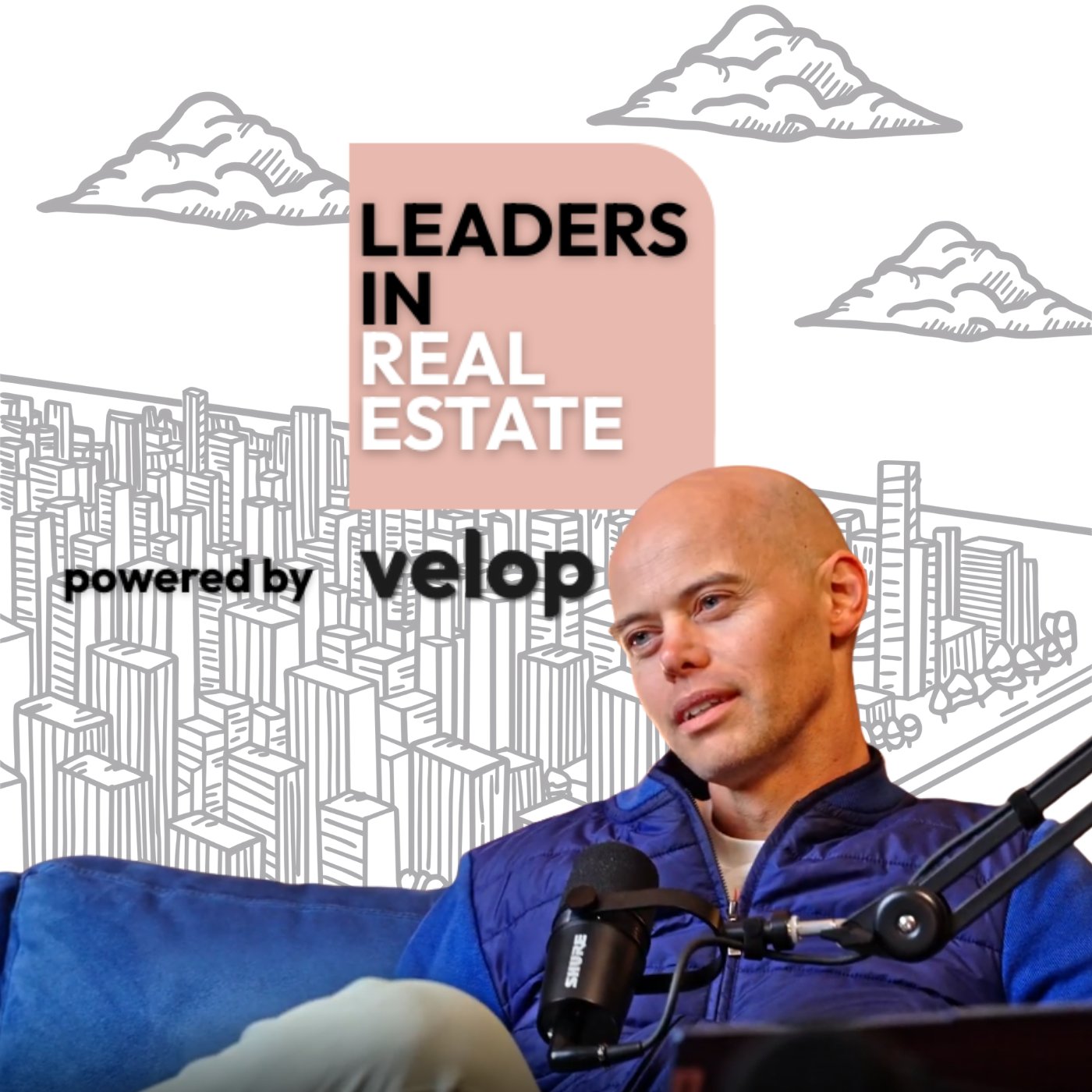
In this episode of Leaders in Real Estate, Velop founder Nick Carman talks to Stephanie Lynch, Chief Investment Officer and CFO of student housing firm Student Quarters, who has executed more than $4.5 billion of debt and equity. Stephanie explains how she helped recapitalize the company days after joining, how she negotiates, and what rising leaders should learn from her mistakes.
Key takeaways
- No one feels ready, and you rise to it anyway. Stephanie was thrown in at the deep end with analyst teams early on, and found that clear communication about timelines and priorities gets everyone to the goal.
- Not asking is the real failure. Hearing no isn't failure. Failing to ask for what you, your client or your firm needs is.
- Persistence plus creativity solves problems. An early boss taught her to keep going through any obstacle and find inventive solutions, a combination she still relies on.
- Practice builds drive. Years of piano taught her there's always a way to improve, and that working at something produces a rewarding feedback loop.
- Past crises are preparation. Running workouts and distressed situations at JLL from 2008 to 2011 gave her the playbook to recapitalize Student Quarters.
- Be direct about risk. She lost a transformative deal when a client didn't hear her warnings. Now "people know what I'm thinking."
- Short-term wins can cost long-term credibility. "Reputations are long, especially in this business."
- Hire for curiosity, communication and openness to change. Forecasts will be wrong, so she wants people who respond proactively when markets shift.
About Stephanie Lynch
Stephanie Lynch is Chief Investment Officer and Chief Financial Officer of Student Quarters, where she leads fundraising strategy, investment deployment and corporate strategy. Over a 25-year career she has executed more than $4.5 billion of debt and equity from domestic and offshore sources. Before joining Student Quarters in 2018, she spent years in capital advisory at JLL, including advising developers, investors and lenders on workouts and distressed assets during the financial crisis. At Student Quarters she led the company's recapitalization and the close of its first discretionary fund in 2023. A classically trained pianist, she studied music from a young age through college.
In this episode
- 00:00 Introducing Stephanie Lynch, CIO & CFO, Student Quarters
- 01:06 Her role leading investment and capital raising
- 01:39 First leadership role: thrown in at the deep end
- 03:20 What drove her: fear of failure
- 04:07 Overcoming fear: not asking is the real failure
- 06:03 What mentors taught her: persistence and creativity
- 07:17 Getting comfortable with difficult conversations
- 08:28 "Outworks and outsmarts her peers": what piano taught her
- 11:02 Four days in: a crisis at the Australian parent company
- 13:54 Did she think about quitting?
- 14:54 How financial crisis workouts at JLL prepared her
- 16:02 Recapitalizing Student Quarters and finding the right partner
- 17:37 Her approach to negotiation
- 19:49 Biggest lesson: be direct about the risks
- 22:36 What she looks for in future leaders
- 25:04 Negative drivers: the danger of short-term wins
- 27:09 Books: Think Again and The Widow Clicquot
- 29:32 Is leadership worth it?
- 30:55 Looking ahead: Student Quarters' second fund
- 33:11 What's next personally: travel, music and yoga
- 33:55 Wrap
Questions answered in this episode
How do you overcome fear of failure in real estate?
Stephanie realized that deals rarely go exactly as planned, and that not asking for what you need is the real failure. Once you stop fearing a no, you can focus on listening to the objections and finding a better solution that moves you toward the bigger goal.
What happened when Stephanie Lynch joined Student Quarters?
Days after she started in 2018, a scandal at the company's Australian corporate partner forced Student Quarters to recapitalize. She drew on her financial crisis workout experience to map governance rights and decision-makers, worked through some false starts with investors, and found a partner who shared the leadership team's vision.
How does Stephanie Lynch approach a negotiation?
She starts with each party's goals, pressure points, what a great outcome looks like and how much pain each side will accept. Then she communicates directly, floats creative alternatives when the conversation stalls, and stays persistent.
What does Stephanie Lynch look for in future leaders?
Intellectual curiosity "first and foremost," strong communication and a willingness to speak up, and openness to change. "The one thing I do know is it is going to change."
What books does Stephanie Lynch recommend?
Think Again by Adam Grant, on challenging your own perspective as markets change, and, for something more fun, The Widow Clicquot, the story of the woman who built Veuve Clicquot after the French Revolution through constant innovation.
Notable quotes
"It is actually a failure to not ask for the things that we want." (04:40)
"Reputations are long, especially in this business." (26:18)
"No one ever says that anymore. People know what I'm thinking." (22:33)
About the host and Velop
Leaders in Real Estate is hosted by Nick Carman, founder of Velop, a real estate executive search firm for investors and developers in the US. Velop uses personality and cognitive assessments at the start of every search so clients can judge culture fit and potential before the shortlist. Contact Velop
Full transcript
[00:00] Introducing Stephanie Lynch, CIO and CFO, Student Quarters
Nick: Welcome to the Leaders in Real Estate podcast. I’m your host, Nick Carman, and I hope this proves to be the mentor in your pocket for future leaders of real estate investment and development. We’re going to talk about the challenges, obstacles and benefits of leadership with the aid of our mentor’s own experience. Stephanie Lynch, welcome to the podcast.
Stephanie: Hi, Nick. Great to talk to you today.
Nick: Thank you very much. For those who don’t know Stephanie, she’s Chief Investment Officer and Chief Financial Officer for Student Quarters, responsible for the firm’s investment and capital raising strategies. Over the course of her career she’s executed more than four and a half billion dollars of debt and equity from domestic and offshore sources. Those are some big numbers, so I look forward to breaking this down, Stephanie.
[01:06] Her role leading investment and capital raising
Nick: To get us started, why don’t you tell us a little more about what you’re responsible for today?
Stephanie: Sure. Today at Student Quarters I’m the Chief Financial Officer and Chief Investment Officer. I essentially guide all of the fundraising strategy and investment deployment for the firm, and I oversee corporate strategy and all of the fundraising and deployment around any of the corporate businesses we’re investing in.
[01:39] First leadership role: thrown in at the deep end
Nick: Let’s wind the clock back, Stephanie. Let’s talk about the first time you were given leadership responsibility.
Stephanie: Early leadership responsibility was with analyst teams in real estate: trying to communicate what we needed to do and the timelines we needed to do it in. I was definitely thrown into the deep end without a lot of coaching early on, which makes it a bit of a trial-and-error way to learn.
Nick: I’m interested. Did you feel ready?
Stephanie: At the time, no. But in retrospect I absolutely was ready. You can very quickly rise to the occasion, and I found that if you’re a good communicator, keep an eye on timelines and priorities, and communicate them to other people, you can get to the end goal. Particularly early in my career, it was exclusively a transaction environment. It was always about which client we had, what their capital needs were, and how we got those deals closed. So the sense of purpose was pretty simple in a lot of ways. It was a matter of making sure everyone was aligned on those goals, working toward the same thing and delivering the same messages.
[03:20] What drove her: fear of failure
Nick: What drove you in those days, do you think?
Stephanie: Certainly some fear. Not wanting to fail. In real estate we all have experiences where transactions don’t close the way we want them to, or aren’t working out the way we want. One thing I’ve certainly realized over time is that however I envision a transaction or strategy ought to go, it’s probably not going to go exactly that way. There are lots of ways to think about success through that, but you’ve got to be flexible and willing to pivot when the circumstances change.
[04:07] Overcoming fear: not asking is the real failure
Nick: Interesting. One thing I’ve promised our audience is to break out a little of our mentors’ toolkit, the skills they’ve honed. So I’d like to dive into that fear of failure, because I bet lots of our audience have had, or will feel, something very similar. How did you overcome it?
Stephanie: Early on, it was really a matter of understanding that we’re not always going to get what we want or ask for in this business. And it’s actually a failure not to ask for the things we want and need, or that our clients or our firm need. It’s not about someone saying no or not getting exactly what you ask for. Trying to optimize an individual situation is what’s really problematic.
Once you get rid of that fear of somebody saying no, or saying, “Well, I don’t want to do that,” you can open it up to: what would a better solution look like? How do we get to the right goal, whether that’s an acquisition closing, a new investment or a new strategy for the firm? And you can really listen to what the objections or concerns are and be thoughtful about the risks. Again, just because someone says no, that isn’t failure. You have to get over that, move past it and see that at the end of the day there’s a bigger strategy here, and keep moving toward it.
[06:03] What mentors taught her: persistence and creativity
Nick: Interesting. The next question I wanted to ask is how the leaders you’ve been around have shaped your own leadership style. What have you taken from them about how you lead people?
Stephanie: Certainly different things over time, from different partners, mentors and clients. A couple come to mind in particular. I had a boss early on in the business who was incredibly persistent. No matter what obstacles seemed to be put in the way, he had the fortitude to continue through and say, “All right, how do we fix this? How do we solve this?” and be really innovative and creative about it. Those dual traits, an incredible amount of persistence and an incredible amount of creativity, have been really helpful to me in my career, and they’re some of the most valuable things I’ve taken from anyone.
[07:17] Getting comfortable with difficult conversations
Stephanie: With certain partners I’ve had, I’ve also really learned that being a good communicator is so important, and that getting comfortable having difficult conversations has been really important to me as a leader. Those can be difficult conversations about a strategy, about individual feedback, about a whole host of things. Being a good communicator means delivering complicated and difficult messages in a way that people are receptive to, so they’re willing to work with you and don’t become defensive, shut down or say, “That’s too hard,” or “too complicated.” You have to be able to continue those conversations, drill into whatever the difficult issues are and say, “Let’s get creative and find a solution.”
[08:28] “Outworks and outsmarts her peers”: what piano taught her
Nick: Okay. In prep for our conversation, I talked to a couple of people who know you pretty well and asked them, “What’s Steph great at?” The great thing is I got lots of answers, but there are a few I want to pick out and spend a little time diving into. This one is similar to a question I asked earlier, but I’d like to go a bit deeper. One of the first answers I got was, “Steph outworks and outsmarts her peers.” I think that comes back to drive. So why do you work harder? How do you navigate better than your peers? What have you got that other people haven’t?
Stephanie: I’m not sure why I work harder. I will say that before I got into real estate, and I didn’t know real estate was where my career would end up, I studied music from a very young age. I studied piano, and I had some very inspirational piano teachers, one all the way through high school and another in college. When you’re studying music, there’s always an opportunity to be a little better, to play a piece better, faster, more nuanced, more precise, more emotional, more whatever.
I think that drive has been practiced through that experience. There’s always an opportunity to improve. I don’t want to say it’s never good enough, because that’s not quite the right perspective to take away. But there’s always improvement available to us in anything, and I’m intrinsically motivated to find where it might be and keep working at it. There’s great reward when you keep working at something and actually get better at it, whether that’s music, sports, your career or whatever. There’s a good feedback loop there, and I guess that’s part of what drives me.
[11:02] Four days in: a crisis at the Australian parent company
Nick: Okay. Another bit of our research I found really interesting and wanted to ask you about was from your very first week at Student Quarters. I was told that four days into your new role, SQ’s corporate partner back in Australia hit the wall, and Student Quarters needed to think fast. I was told this would not have happened without you, which is quite a statement given how short your tenure had been. They finished the anecdote by explaining that Steph is a tremendous negotiator, and as a consequence they came out of that position stronger.
So let’s wind the clock back and think about that scenario. How did you respond? How did you react? This was a very different climate, a different team, a different business, and possibly a different challenge from anything you’d faced before. How did you come out with such a positive result?
Stephanie: It was really an incredible shock. I thought I’d done all my background and due diligence on Student Quarters and their corporate partner back in Australia. Within a couple of days of my starting, there was a scandal at the Australian firm. It had nothing to do with Student Quarters or, quite frankly, any of their US-based businesses, but it became a very serious situation very quickly.
All of a sudden, instead of doing what I’d been hired to do, which I had lots of experience with… I was hired to bring in institutional LP partners for student housing deals. I hadn’t done that for student housing, but I’d done it for lots of other real estate strategies, and I knew all the right players. I actually started the job thinking, “This is a great place to be. I couldn’t be luckier. How stable is this going to be? This is something I can do.” And I was immediately hit with, “No, we have to recapitalize the whole company.” It was very much a surprise, and a requirement to start from scratch. Whatever I thought I’d be doing in this new role was going to be put off for a few months until we understood exactly what this change meant for Student Quarters and figured out how to extract ourselves from it.
[13:54] Did she think about quitting?
Nick: Did you ever think about… I mean, four days in, you haven’t got much skin in the game at this point, Steph.
Stephanie: Quitting and going back to my old job? I did. But I had left my prior role for a reason. I’d left because I didn’t see myself spending the rest of my career there. And I thought, “I’ve already said goodbye to that. I’ve already said that’s not where I want to be. What’s the worst that happens? We’ll probably figure it out.” I actually gave myself 12 months. I sat down with my husband and we talked about it and said, “All right, 12 months. We’ll see how this works. If it works out, great. If it doesn’t, we’ll go do something else.” But I never really thought it wouldn’t work out.
[14:54] How financial crisis workouts at JLL prepared her
Stephanie: During the financial crisis, which was a really difficult time for a lot of people in real estate, I was working at JLL. We pivoted from raising capital for developers to helping both developers and investors get through their workouts and distressed assets. From essentially 2008 until 2011 or so, I spent a lot of time digging deep into the source of the distress: what the capital stack looks like, what governance rights each party has, who’s in control, who can make these decisions, and how we get to an answer that preserves as much value as possible for whoever my client was at the time. That might be the developer and GP, the LP or, quite frankly, the senior lender, because we were advising on lots of different transaction types with lots of different clients.
[16:02] Recapitalizing Student Quarters and finding the right partner
Stephanie: That experience made me think, “This is pretty applicable here.” We had to figure out what the governance rights were and who would be able to make decisions. And it became an opportunity for Student Quarters to say, “We thought the next three to five years were going to look like X, and instead they’re going to look like Z. Let’s go find a partner who will help us do that.”
It was a lot of quickly trying to understand what the company could do, where we were and what we needed, and trying to match that with investors who had the same vision for participating in an operating company platform investment as well as the deal-level investments. It was a great opportunity to talk to a lot of people. There were definitely some false starts in that process, where we spent time with certain investors only to discover it wasn’t going to work out the way we thought it might. But ultimately we ended up with a great partner who really understood Student Quarters, understood the leadership team and what we were trying to accomplish, and really helped us build Student Quarters into the next vision of what we wanted to be.
[17:37] Her approach to negotiation
Nick: The last part of that research mentioned your spectacular negotiating skills, and again, I want our audience to benefit. Do you have a way of looking at negotiating? A template, or a way of approaching these discussions?
Stephanie: The approach is very situation-specific, for sure. I think it starts with: what are the goals of each party? What are each party’s pressure points? What would a great outcome look like? And how much leverage or pain is each party willing to accept as you go through it?
I’m not sure I have any special sauce there, other than that I’m a good communicator. I’m happy to get into that conversation very directly and try to sort through the answers people are looking for. Part of it, too, is being creative and throwing out different solutions. When one party says, “I need A,” and the other says, “I need B,” you can’t just keep having the same conversation over and over again. You’ve got to float some different ideas, get creative and be a bit more innovative about what the solution could be. Maybe it borrows from something we’ve done in the past, or something someone else in the industry has done that we’re aware of, and maybe it’s something new. You just have to keep that line of communication open and keep pushing forward. And I’ll come back to the beginning: being really persistent. That’s something I learned from an early boss: be really, really persistent and creative as you approach these things, and more often than not you’ll get to a really good outcome.
[19:49] Biggest lesson: be direct about the risks
Nick: Okay, we’ve talked about a lot of the successes. Mistakes happen in everyone’s career. Are there any that haunt you? What were some of the biggest mistakes, or the biggest lessons you’ve learned from them?
Stephanie: You’re learning all the time. Even after 25 years in my career, I’m learning new lessons all the time. Early on, though, the hardest lesson came from working with a client for whom I was an adviser raising capital. They had a pretty interesting strategy around mixed-use development and the recapitalization of some existing assets, and I’d brought some potential investors to the table.
I knew there were some pressure points, and I’d tried to communicate them. I’m not sure my client at the time heard the risks and those pressure points. Ultimately they made some decisions and blew it up. That deal would have been transformative for them, and it would have been transformative for my career had I closed it. When I look back, I think, “Gosh, maybe I should have been a bit more direct in my communication. Maybe I should have been more forceful in presenting the risks: if you change the deal this way, I believe it will have these negative outcomes.”
That’s led me to be very vocal about what I think the right strategies are. Ultimately I don’t get to make every decision, and there are other parties involved, but everyone is going to know exactly where I stand and why. That was one example of a very important transaction, for me and for the client, where I thought I’d communicated well enough what would happen if certain changes were made, and they didn’t seem to internalize or accept it. I don’t want anyone ever to say, “Stephanie didn’t explain it well enough,” or “I’m not sure what Stephanie was really thinking.” No one ever says that anymore. People know what I’m thinking.
[22:36] What she looks for in future leaders
Nick: Right, let’s move on to the next chapter of our conversation. This is the point where I want our audience to feel like they’re sat in the room with you, really benefiting from your mentorship. When you’re thinking about future leaders in your business, or interviewing for potential junior leadership roles, what do you look for? What are the defining characteristics of a great future leader?
Stephanie: I think intellectual curiosity is first and foremost a requirement. People need to want to learn. They need to want to understand how our business works, how it’s going to work in the future and how it’s going to change. That curiosity about why we’ve done something a certain way in the past, or why people think about things a certain way, is really important for the people I hire.
Being a good communicator, which I know I’ve mentioned and I’m sure I’ll harp on more, and being willing to speak up is super important as well. And the other thing I’d add is the ability to be really innovative and thoughtful about change. Wherever we are in our careers and businesses, I spend a lot of time forecasting, both for our individual assets and for our corporate strategy and corporate finances. While it’s important to think about what will happen over three to five years and work toward that, the one thing I do know is that it’s going to change over that period. We’re going to have to respond to that, and hopefully be not just reactive but really proactive about the changing capital markets environment, leasing environment or whatever it might be. So people who are open to change and really willing to embrace it, rather than resist it, are super important. That’s definitely one of the characteristics I look for.
[25:04] Negative drivers: the danger of short-term wins
Nick: Okay. I asked you earlier about what drives you, and there are lots of different drivers. I suspect if I asked what drove you in the early days and what drives you today, you might give me two different answers. But for the benefit of our audience, are there any negative drivers, anything you think people should avoid or quieten because, in your experience, it leads to the wrong type of drive?
Stephanie: That’s a great question. When I think about what I’m driven by, I like the challenge of the work I do, and I like a win. I think anyone in real estate in a transaction environment likes a win. We’re all deal-oriented people. But the caution I’d add is that it’s not only about the win. You have to think about what a win is in the long run, and never go after a short-term win that won’t also get you to your longer-term goals.
Reputations are long, especially in this business. Your credibility is important and very difficult to re-establish if there are issues there. As I’d advise people: yes, we all want to win the deal. We all want to post another closing trophy, go to another closing dinner and have all that good adrenaline that comes with it. But let’s always do it in a way that speaks to long-term success. You occasionally see people who don’t make the right decisions for the sake of a short-term win, and I’ll always say it will come back to haunt you in the long run.
[27:09] Books: Think Again and The Widow Clicquot
Nick: Let’s talk resources. For anyone listening, what book or content would you recommend they dive into to benefit their career journey?
Stephanie: I love that question. I’d first say: read lots and lots of things. Business books, fiction, non-fiction. The more our perspectives are broadened through reading, listening, podcasts and so on, the better we’ll all be as leaders and innovators in business.
A current favorite is, of course, Adam Grant, the Wharton professor, and his book Think Again. It talks a lot about how you challenge your perspective in a given situation, how you evolve as markets change, and how you think carefully about what that evolution might look like. I think that’s incredibly important for anyone in business today, so I’m a big fan of his work.
I also have a second recommendation, which is maybe a bit more fun.
Nick: No surprise, given the background here. Bring it on.
Stephanie: I think they’re both on the bookcase here, actually. The other book I’d recommend, from a fun perspective, is The Widow Clicquot. It’s about the founding of the house of Clicquot and the woman who established it right after the French Revolution. She was really a force to be reckoned with: her ability to work out how to sell champagne in a very difficult environment, across changing governments and regulatory regimes, and her innovations in how to make champagne, how to store it, and how to make bottles sturdier and fit for shipping. Really fascinating. That’s a fun one.
[29:32] Is leadership worth it?
Nick: Thank you very much. I’ll make sure I add both to my list. We’ve talked a lot about leadership, so I wanted to ask a personal question. Is it worth it?
Stephanie: Absolutely. I like what I do. I feel that over time I’ve become a bit of an expert in the one area I work in, and I get a lot of satisfaction, a lot of intellectual satisfaction, from that. It doesn’t hurt that the compensation’s not terrible, either. That’s always part of it. But the people I get to work with, the challenging situations that come up, and being able to come up with a solution and sort it out… that complex problem-solving is just intellectually satisfying to me, and I find it worth it. I love the people I get to meet and work with. I hope we create a good environment for people to work in, where they feel secure in their jobs and feel they have career advancement opportunities. Working with younger people in the business is something I really enjoy, and it really motivates me.
[30:55] Looking ahead: Student Quarters’ second fund
Nick: I’m really glad to hear it. We’ve spent a lot of time looking backward, so let’s turn this around and look forward. What are you looking forward to, in your career and corporately? Let’s go corporately first.
Stephanie: Corporately first. As you mentioned, when I joined Student Quarters in 2018, we were immediately hit with a pretty big surprise. It’s felt like a lot of growth and a lot of activity in the last six years. One of the challenges is that while we keep growing the company, our assets under management and our resources for operating and delivering for our investors, we sometimes don’t take a moment to enjoy the successes we’ve had, and I’m personally pretty bad at this. We don’t look back and say, “Wow, what we’ve been able to do is pretty cool.” So I’m really looking forward to enjoying that a little more and feeling that we’ve hit some really important milestones in the growth of the company and the stability of our portfolio. That’s really important to me.
Also, corporately, in 2023 we closed our first discretionary fund. That was a big deal. It’s not a great fundraising environment, especially for boutique strategies and first-time fund managers. We’ve now launched our second fund and had our first closing. I see this as a really exciting time, where we’re adding different opportunities to our toolbox in terms of how we can attract different investors and deploy money for them, and it will give us a lot more tools for how we approach the market.
[33:11] What’s next personally: travel, music and yoga
Nick: What about personally?
Stephanie: Personally, I’ll be an empty nester next year, so all of a sudden that changes a whole lot of things. Both of my kids will be in college. I love to travel, and I love going to see live music of all kinds. Music is still a very important part of my life. Being able to spend more time with family, more time traveling and more time exploring music is really important to me, and as I look toward the next few years, I’ll have more opportunity to do that. I’m also toying with getting my yoga teaching certificate, so we’ll see if that happens.
[33:55] Wrap
Nick: Wow. Well, on that really positive note, I think we need to wrap this up. You’ve been incredibly generous with your time and the lessons you’ve shared, opening up this toolkit, and I have no doubt our audience has really benefited. Thank you so much.
Stephanie: Thank you. It’s been great talking with you, Nick.
Nick: It really has. Thanks very much.
Published November 24, 2025. At the time of recording (October 2025), Stephanie Lynch was Chief Investment Officer and Chief Financial Officer of Student Quarters.