
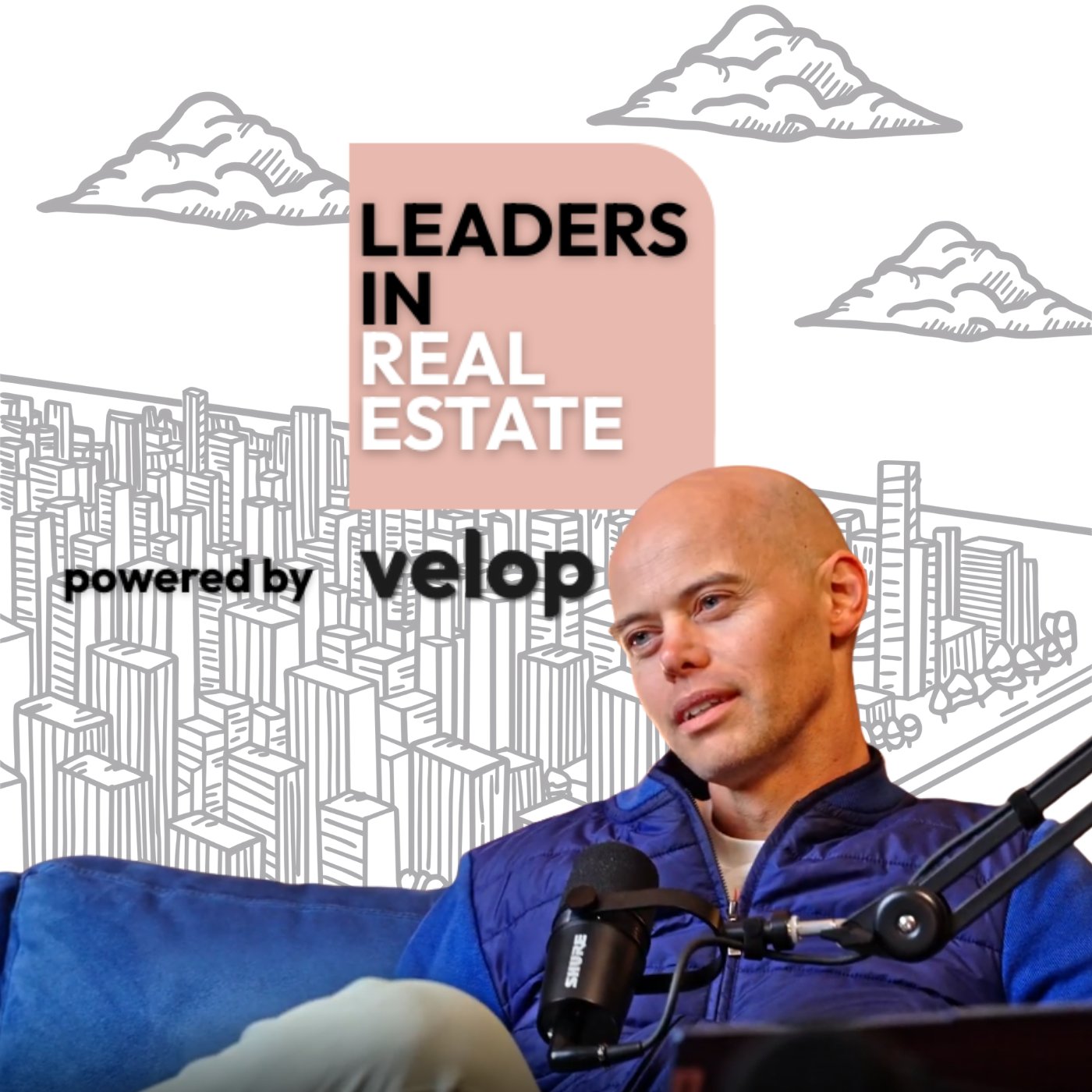
In this episode of Leaders in Real Estate, Velop founder Nick Carman talks to Spencer Levy, Global Client Strategist and Senior Economic Advisor at CBRE and host of The Weekly Take. Spencer shares the speech that changed his career, the communication mistakes he made early on, and why he looks for preparation and focus in every future leader.
Key takeaways
- Leadership isn't a box on the org chart. It has two parts: running an organization, and mentoring people so they get better. "The goal of leadership is to make people around you better. Period."
- Know yourself first. "The most important picture on your wall is your mirror." It tells you what you're good at and what you want to do.
- Courage creates opportunity. Spencer's decision to present his own way in front of 3,500 people changed the direction of his career.
- How you say it matters as much as what you say. Spencer admits he was "brash" and "arrogant" in New York. Saying the truth badly "puts a wall" between you and the other person.
- Never raise your voice. His father's rule: "The minute you raise your voice, even if you're right, you're wrong."
- Don't just chase the next rung. Taking roles because they looked prestigious were among his biggest mistakes. Learn broadly early, then double down on what you're best at.
- Get one great thing done a day. Spencer plans his travel around one "anchor" meeting and builds everything else around it.
- Think long term. He walks away from short-term wins that hurt long-term relationships, and still loses deals without trying to force them.
- Prepare. He judges interview candidates on preparation, not whether he'd want a beer with them.
About Spencer Levy
Spencer Levy is Global Client Strategist and Senior Economic Advisor at CBRE, the world's largest commercial real estate services firm, where he advises the firm's largest investor and occupier clients worldwide. Over a 30-year career he has worked as a lawyer and an investment banker, and in almost 18 years at CBRE he has led Americas research, retail capital markets, Latin American capital markets and restructuring. He hosts CBRE's podcast The Weekly Take, gives around 200 live presentations a year and teaches public speaking. He holds an industrial and labor relations degree from Cornell.
In this episode
- 00:00 Introducing Spencer Levy, CBRE
- 00:59 His role: advising CBRE's largest investors and occupiers
- 02:16 The backstory: lawyer, banker and 18 years at CBRE
- 03:40 Leadership isn't just the org chart
- 05:10 The speech that changed his career
- 07:27 Telling the truth: what great mentors did for him
- 09:33 Tactical mistake: learning to communicate better
- 13:35 Strategic mistake: life is a jungle gym, not a ladder
- 16:53 Managing a brutal schedule: one anchor task a day
- 19:18 Has leadership changed for the next generation?
- 21:21 Building a personal brand: find your own voice
- 23:33 Corporate real estate is a revenue tool, not a cost center
- 26:28 What drives him: fear of failure
- 28:49 Good and bad drivers: always think long term
- 31:23 What he looks for: preparation and focus
- 34:02 What to read, and why you need a hobby
- 37:49 How to measure success: happiness
- 39:43 Wrap
Questions answered in this episode
What is leadership, according to Spencer Levy?
Spencer sees two elements: the formal running of an organization, and the softer work of mentoring, leading by example and giving advice so others can be better. His first leadership opportunity, he says, is the first time you help someone more junior, whatever your title.
How do you communicate more effectively as a leader?
Every conversation is public speaking, from the stage to the elevator. Be persuasive, be aware of your emotions, and deliver the truth in a way that builds connection rather than a wall. And never raise your voice.
How does Spencer Levy manage such a busy schedule?
He reads for the first couple of hours each morning, then focuses on one important thing for the day. On the road he books one "anchor" meeting per city and plans five more around it. "It sounds simplistic, but it is what works."
Should young professionals build a personal brand?
Yes, but in their own voice. Spencer uses only LinkedIn and guards his voice "jealously." He tells stories because "persuasion is not an intellectual process... it's an emotional one," and advises against letting others post for you.
What does Spencer Levy look for in future leaders?
Preparation and focus. When candidates interview with him, he expects them to have read what's publicly available about him. "If somebody's really prepared, then they'll prepare for the next task at hand, which is to help our clients succeed."
What books does Spencer Levy recommend?
Books by Adam Grant and Angela Duckworth, and Esther Choy's work on storytelling. But he also says to read beyond business and get a hobby: studying horse racing psychology taught him lessons he applies to real estate.
Notable quotes
"The most important picture on your wall is your mirror." (05:36)
"The minute you raise your voice, even if you're right, you're wrong." (13:23)
"Life isn't a corporate ladder. Life is a jungle gym." (from mentor Laura O'Brien, 14:41)
About the host and Velop
Leaders in Real Estate is hosted by Nick Carman, founder of Velop, a real estate executive search firm for investors and developers in the US. Velop uses personality and cognitive assessments at the start of every search so clients can judge culture fit and potential before the shortlist. Contact Velop
Full transcript
[00:00] Introducing Spencer Levy, CBRE
Nick: Welcome to the Leaders in Real Estate podcast. I’m your host, Nick Carman, and I hope this proves to be the mentor in your pocket for future leaders of real estate investment and development. We’re going to talk about the challenges, the obstacles and maybe even a few of the benefits of leadership with the aid of our mentors’ own experience. So, let’s go.
Today I’m joined by Spencer Levy, Global Client Strategist and Senior Economic Advisor for CBRE, the world’s largest commercial real estate services firm. He’s a lawyer, investment banker, globetrotter, and the voice of commercial real estate to the largest investors and occupiers. Spencer, welcome to the podcast.
Spencer: Nick, thanks for having me. What a pleasure.
[00:59] His role: advising CBRE’s largest investors and occupiers
Nick: The pleasure is all mine, Spencer. Why don’t we get started? Tell us, essentially, what your responsibilities are today.
Spencer: I think you’ve nailed one of them, which is that I travel every single day, all over the world. And what am I doing? I’m meeting with the largest investor and occupier clients of the firm and of the industry. It’s an unusual position. Most people in our industry cover one side or the other. I’m very fortunate to cover both, and it helps me with both, because I get real perspective on what’s going on.
The responsibility includes a variety of things. The things you see on the surface include the podcast, The Weekly Take, which we’re very fortunate has been very successful. I do a tremendous amount of stage work. I probably give 200 live speeches a year to industry organizations, internally and externally, and one-on-one with clients, and then I meet with clients one-on-one outside of speeches. Global client strategist means I’m giving advice every day to our largest clients on what the trends are and what they should be thinking about. So, to cut right to the chase, it’s a fun job.
[02:16] The backstory: lawyer, banker and 18 years at CBRE
Nick: I’m glad to hear it, and I’m sure we’ll dig into that a little more. Let’s wind the clock back. What got you to this post? What’s the backstory?
Spencer: The backstory is that I’ve been in the business for 30 years. As you pointed out, I was a lawyer, and I was a banker. I’ve been at CBRE for almost 18 years in a variety of roles. The joke, which I’ve said to some of my colleagues, is, “You can call me whatever you’d like.” They used to call me head of Americas research. They used to call me head of retail capital markets, head of Latin American capital markets, restructuring. The list is endless. I said, “Whatever job title you give me, my job is the same: give the best advice possible to our clients, period.”
That’s what I’ve done, and I’ve kept doing it using new forums. I used to do a lot of white papers and write a lot of blogs. I stopped, and not because they’re bad. Believe me, to my colleagues who write those white papers: amen, because I use them every day. I’m not telling you to stop. But I think my voice gets amplified in other ways, the four I just laid out: the podcast, the stage work, the one-on-one meetings, and I’m also a very active user of LinkedIn. And as you noted on our pre-call, Nick, my travails on the road are sometimes pretty funny.
Nick: I definitely agree with that. Anyone who doesn’t follow Spencer already is missing out, frankly.
[03:40] Leadership isn’t just the org chart
Nick: Let’s get into chapter two and talk leadership, Spencer, and those early days of leadership in particular. When was your first opportunity to lead?
Spencer: I don’t think leadership is just a function of where you sit on the organizational chart. Your first opportunity for leadership is the first time, early in your career, that you had a conversation helping somebody more junior. It could have been while you were in high school. Look, the formal definitions of leadership are important. They’re real. Look at every corporate org chart. But leadership isn’t just that.
There are two basic elements of leadership. One is running an organization. The second is the softer part: mentorship, leading by example, giving advice to others so they can be better. The goal of leadership is to make people around you better. Period. So your organization can thrive, be more productive, and so everybody can be better. There’s the org chart part of it, and then there’s the leadership related to mentoring and making the people around you better so the organization is more productive. I’d say I’ve been doing that for a long time, since well before I was even in business.
[05:10] The speech that changed his career
Spencer: But my current role really started about 12 years ago, when I had the key moment. I’m going to get on my soapbox here for a moment, Nick, because here comes the key moment of everybody’s career.
Back in April, I was very fortunate to give my first quasi-commencement talk at Auburn, to their real estate group. My good friend Greg Winchester runs that group. In the speech I said, “The most important picture on your wall is your mirror. It tells you who you are. It tells you what you’ve got. It tells you what you want to be and what you like to do.” And then you’ve got to have the courage to do that.
I had a real moment about 12 years ago at what was known as the Americas Summit, in the Denver Convention Center, in front of 3,500 people. At that point I believe I was running Americas research, and things were going fine. But I knew there was a better way. I just knew it. There was a better way to communicate. I use the word courage because it was not the safest move I ever made. I said, “This speech is going to change my life, positively or negatively.” You’ve seen a thousand economic speeches, and I have no knock on them. Most economists are way brighter than me. But what I felt they didn’t do as well was communicate effectively.
So I said, “I’m going to do this my way.” My way was highly engaging, with lots of pictures. I had a costume change during that presentation.
Nick: Spencer, is this the video where I’ve seen you dressed up as a New York cabbie?
Spencer: That is the video where you saw me dressed up as a New York cabbie.
Nick: There’s a lovely little Easter egg for anyone who wants to go and dig that out.
Spencer: If you want a really deep Easter egg, go find the video of me running down the aisle, The Price Is Right. That one is truly priceless. But the point is, it took courage to give that speech in front of 3,500 people, and I’m telling you straight up, it changed my life. It changed my life in terms of doing what I thought was more effective for our clients. And I wouldn’t be sitting on this show without that speech.
[07:27] Telling the truth: what great mentors did for him
Nick: Let’s dig into this a little. You’ve talked about being a leader from very early days, and taking quite a novel approach to what leadership means, even before it was bestowed on you as a title. Have you always felt comfortable with it?
Spencer: I’d say I’m very comfortable, maybe too comfortable, maybe sometimes uncomfortably comfortable, telling the truth. It’s the most powerful thing in the world, and you have to be very careful how you express it in certain contexts. But if you have a relationship of trust and you can give it to people straight, that person is your leader, whether or not they have a higher title than you.
Every mentor I’ve had in my career, and I can name a few on this show, and if you’re listening, nothing but love here, from Steve Swerdlow to Laura O’Brien to Chris Ludeman… the list is endless. They all told me the truth, and they all made me better. I’ve tried to use those lessons for others. That’s really what I think great leadership is: speaking and communicating with people in a way that makes them better.
Here comes another truth bomb. Because I’m the front guy on so many things, on stage and on the podcasts, I get a lot of accolades. Those aren’t mine. They’re my team’s, because I go up there, take their best ideas and communicate them as well as I can. That’s what leadership is. Leadership is effective team dynamics, and as a leader on that team, your job is to make the team better. The team makes me better, and I hope I make them better. I hope I don’t annoy them too often when I’m on the road at 3:00 in the morning and my contact lenses get stuck to my eyeballs, which was one of my recent LinkedIn stories. But that’s how I see it.
[09:33] Tactical mistake: learning to communicate better
Nick: We’ll revisit more of your lessons on leadership a little later. But let’s get uncomfortable and talk about mistakes. One reason for doing this podcast is to share with our audience when things have gone wrong, career car crashes for our mentors, so our audience can learn in a safe environment. Thinking back, what were some of the most uncomfortable mistakes in your earlier career, Spencer, and what can we all learn from them?
Spencer: They’re both strategic and tactical. For people who aren’t familiar with the two terms, strategic is big-picture and long-term. Tactical is in the moment.
Nick: Okay.
Spencer: Let’s start with tactical, in the moment, because I think it’s the one people can work on today, and I think everybody should. I’ve become much more modulated in the way I speak. Even on this show, I’m speaking very matter-of-factly and calmly. When I lived and worked in New York, I spoke very brashly. I spoke arrogantly. I’m not proud of that, not proud of it at all. But that’s how things went in New York, and to survive, the dog-eat-dog mentality was real. Then I took some of that with me when I left New York. I left 25 years ago and moved to Baltimore, and, as Keith Moon would say, it went over like a lead zeppelin. For you non-music aficionados, Keith Moon was the drummer for The Who, and the story goes that he named Led Zeppelin by saying that to Jimmy Page at a bar.
Anyway, knowing how to communicate is so important. This is the tactical part: just communicate better. One of the things I do is teach public speaking. And you know what public speaking is? Every conversation you ever have. This podcast is public speaking, and the stage is public speaking. When you’re in the elevator and the CEO walks in and asks who you are and what you do, that’s public speaking. Do it right and do it effectively. And here’s the key word: do it persuasively.
I’m not saying don’t emote. I said I was too emotive in New York. I was arrogant, and I used a lot of salty talk, as they might say. But I learned that in every forum there’s a way to communicate more effectively. It’s basically finding ways to tell the truth more effectively. I could say, “Nick, that’s a great sports jacket, but that T-shirt doesn’t match it.” Okay, I could say that. But I could say it much more nicely, in a way that would be more persuasive, because the way I said it first would have put a wall between us. Even though I’d be saying the same thing, saying it in an arrogant, too-direct way puts up a wall. You don’t want walls between you and the next person. You want connections, and to create those connections, you need to communicate effectively.
So I think the biggest error I made early in my career, and believe me, I still have to fight it sometimes: always, always, always communicate as effectively as you can in that moment. Be aware of your emotions and how things affect you. And if you’re mad, never raise your voice. Ever. These are little tips from the road. Just don’t do it. Remember I said leadership starts young? Forty years ago my dad said, “The minute you raise your voice, even if you’re right, you’re wrong.” It’s black and white in my book. So that’s tactical: communicate better. We can go into public speaking 101 as much as you’d like.
[13:35] Strategic mistake: life is a jungle gym, not a ladder
Spencer: Strategically, it comes back to what I said earlier about that mirror. You have to know who you are. I was a lawyer, and I didn’t love it. I was a banker, and I liked it. I’m a leader, and I love it, in my own way. I love my type of leadership. I don’t like the type of leadership that’s very granular about the P&L, so to speak. There are people out there who love that stuff, and you know what? Great. Do that. What I really love is being out on the road with our biggest clients, advising them every day, everywhere.
But I needed to find the path, the courage and the opportunity. There isn’t always the opportunity, which is why these opportunities didn’t come to me until my 40s. The strategic mistakes I made came from looking at the corporate ladder and saying, “I want the next rung.” One of my great mentors, Laura O’Brien, said to me, “Life isn’t a corporate ladder. Life is a jungle gym. Sometimes you get the corporate ladder. Sometimes you get the monkey bars. Sometimes you get the slide.” She was 100% right.
But a few times in my career I said, “I’d rather take the next rung on the ladder, because it looks cooler, or pays more, or it’s more prestigious.” It wasn’t me, and those were mistakes. And this isn’t a follow-your-star speech. Early in your career you have to do a lot of things you probably don’t love, and some things you may not be the best at. What you need to do, and I’ve said this to a thousand people I’ve worked with, is start early in your career by learning as much as possible, about as many things as possible, and eventually get to the point where you’re doing what you want to be doing.
It took me 20 years into my career to finally be doing what I love. I wish I’d got there sooner. I wish I’d had the courage to do it sooner. But it’s not just courage. I wish I’d known sooner. So often in our careers, our choices aren’t dictated by that mirror on the wall. They’re dictated by the real or perceived expectations of others, and people need to move away from that. That’s tough, because sometimes those others are your parents. Sometimes they’re colleagues. And these people may have your best interests at heart. They’re not bad people steering you wrong. But eventually it’s about finding out what you’re good at and doubling down. I’m the first to admit my flaws, and there are many. But when there’s something I believe I’m really good at, or at least better than most at expressing to others, I double down. And I tell everybody to do that. Find something where you’re the best, and be that.
Nick: I think that’s really good advice.
[16:53] Managing a brutal schedule: one anchor task a day
Nick: While we’re on the topic of advice, Spencer, you run a hectic schedule: I hear 150 to 200 in-person presentations a year, with a huge amount of globetrotting travel. While I can’t imagine our audience is quite so busy, I do want to give them some advice on making sure nothing falls through the cracks. How do you stay so organized? How do you stay on top of a schedule and a diary like that?
Spencer: Fortunately, I have a team that helps me with that, because there are things I’m very good at and things I just need help with. Particularly in the last three weeks, I think I’ve been to 12 or 15 cities. I had three midnight flights last week. Three in one week. Actually, four. Forgive me, I missed one. After the third, my contact lenses and my eyes staged a revolution, and I literally had to give a speech in Kansas City on Friday wearing sunglasses because I couldn’t see. There are physical ramifications to the madness of the schedule.
But every day of my career has had pretty much the same structure. I get up early every day. Not super early, but I spend the first couple of hours of the day, from 7 o’clock in the morning, reading. I read the paper, the business news and research. Then I have my most important thing of the day, every day. It’s really important. I think you get one great thing done a day. One, not ten. One. And then I plan around it.
So when I go to a city… I’m going to Tampa on Monday to meet a good friend of mine, Randy Anderson, who runs the University of South Florida’s real estate research program. What did I do? I scheduled five meetings around that. I’m going to Dallas next week. I’ve got my anchor meeting, and five meetings around it. That’s been my strategy: get these anchor meetings, as I call them, and plan around them, doing the same for other clients. It sounds simplistic, but it’s what works for me. Try to get one big thing done a day, and plan around it.
[19:18] Has leadership changed for the next generation?
Nick: Imagine we’re now in a one-to-one mentoring session, Spencer. I think our average listener is probably 28 to 35, getting their first taste of leadership right now. Do you think leadership has changed for that generation? Is it different from when you and I first tasted it?
Spencer: “Mercy, mercy me, things ain’t what they used to be.” Every generation blames the one before.
Nick: That’s Marvin Gaye.
Spencer: There have been hundreds of books, and we’ve had authors on the show, about Gen Z, millennials and Gen X. By the way, that’s me: the forgotten generation, and we are the awesome generation, folks. Do I think leadership has changed? What people have suggested has changed is that people have merged their values and their work ethic into one thing. So are people different in certain circumstances? I had an author on my show last week who talked all about that, and lots of books have been written about it.
But ultimately, no. I’m going to come down hard on this one. No, leadership hasn’t changed. People may have changed: they get married later, maybe they have kids later, maybe their values have changed. But ultimately, being a good leader means taking the ingredients, which are the great people we have, and making them better. The fundamentals of leadership haven’t changed. People may have changed a little, and teams may have changed a little. Great leadership will always be great leadership.
Styles of leadership can change. I used to use the example of the old-school football coach who didn’t always have a nice way of putting things, versus the new-school softer touch. Some of those things have changed a little. But the fundamentals of good leadership, I think, are universal.
[21:21] Building a personal brand: find your own voice
Nick: There’s something I want to ask that I think is pretty unique about Spencer. Let me put it in context. Commercial real estate as an industry is often accused of lacking personality. I don’t think it does a good enough job of selling itself. Compare that with Spencer. You’ve honed the idea of a personal brand. We talked at a very early stage about your LinkedIn content and how successful it’s been. What I really wanted to ask is how that has affected your career, and how important it is for our audience of 28- to 35-year-olds. Is this something they need to make time for, or something they don’t need to worry about?
Spencer: You say LinkedIn. I use a broader term: my voice. And when I say my voice, I mean my voice, and I guard it jealously. When people try to push back on my voice, I say, “Look, that doesn’t sound like me, and the audience isn’t going to buy it.” I think it’s essential that everybody develops their personal voice, whatever it is. I’m not saying I’m perfect by any stretch of the imagination, but I have my own, unique voice, and people know it when it’s coming.
They know I use a lot of pop culture references, like I have on this show, and I tell a lot of funny stories, like I do on LinkedIn. They aren’t there just because I enjoy doing them. Do I enjoy them? Yes. But I do them because they’re purposeful. Their purpose is to persuade. And persuasion isn’t an intellectual process. We like to say it is, but it’s not. It’s an emotional one. You need to drop from people’s heads to their hearts. And how do you get from people’s heads to their hearts? By telling stories. And the essence of stories is funny stories: personal stories told in your own voice.
[23:33] Corporate real estate is a revenue tool, not a cost center
Spencer: Going back to your specific question about corporate real estate being dry and stodgy, or whatever term you used, I think I summed it up correctly. I love going in front of corporate occupier audiences, because I tell them this. I say, “How many of you report to people who are trying to save one cent here, two cents there, three cents there? Great. Here’s another way to look at the world. You’ll still have to do whatever that corporate person told you to do. But your job is to persuade the powers that be, whoever they may be, that corporate real estate is a revenue generation tool. It is not a cost center.” That’s the fundamental shift. It’s a tool of productivity, not a tool of efficiency. That’s the split.
When you say those words, people say, “Oh no, you can’t say that.” And I say, “Well, I just did, didn’t I?” I say it in front of every corporate audience, and believe me, the audience loves it, because they’re craving it. They’re craving the creativity it gives them the ability to bring.
My current stage presentation is called All You Need Is Love. Yes, it’s a Beatles-themed presentation. What I mean is that most real estate is a want, not a need. You really only need two forms of real estate: housing, a place to live, and industrial, a place to store your stuff. Everything else is a want. You’ve got to want to come to the office. You’ve got to want to go to retail. You’ve got to want to be on this podcast. A lot of things are wants, and if that’s true, make people love going there and you’ll do better than the next person.
So, back to LinkedIn: I recognize the biases some may have about corporate real estate. I’m not that guy. I’m the guy pushing against that. I’m the guy saying, “No, be more creative, be more productive, grow revenues,” and the way you do that is by making people love being there. That’s a simplification of the argument, but LinkedIn helps. By the way, it’s the only social media platform I use. I don’t use any of the others. I like it because it’s professional, and I need a certain level of professionalism to do this. But you should develop your own voice. If anybody comes to you and says, “We’ll post for you,” please don’t do that. I know a lot of people do, and I still love you, nothing but love here. If that’s you, you be you. But I think you’ll be more effective in your own voice.
[26:28] What drives him: fear of failure
Nick: Let’s talk drivers. You gave me an insight into your morning routine, Spencer, but what drives you? What gets you out of bed?
Spencer: This is an answer I give a lot, and I’m not proud of it, but I’ve said it in public and I’ll say it again on this show: fear of failure. When I feel I’m not going to succeed, I get nervous and I fear it. And doggone it, I wish that weren’t the case. What I wish were true is that my motivation was all positive: all wanting to do the right thing rather than needing to do the right thing. You with me? It goes back to the want-and-need idea. I need to do it.
I’m actually not proud of it, and I try everything possible not to use negative reinforcement with anyone, because I never want people to fear failure. There are a lot of people for whom it works. But I’ll be black and white, 100%: don’t use it as a motivator, because it can be debilitating. Part of your crazy drive ends up built on wanting, or rather needing, to succeed. I don’t want to get all Freudian about where it came from, my parents or otherwise, but it’s there, and there are healthier ways.
Nick: How do you quieten it? Without going too deep, Spencer, for anyone listening who recognizes that fear of failure in themselves, how do you stop it being debilitating? How do you stop it becoming paralysis?
Spencer: I try to simplify. I go right back to it: I have my one anchor thing, and I plan around it. It’s methodical. If you march down that methodical path, you’ll be able to control it better. But ultimately, I try to keep negative thoughts out, and I drink a lot of coffee.
[28:49] Good and bad drivers: always think long term
Nick: Let’s talk about drivers for our audience. What are good drivers, and what are bad ones?
Spencer: If you’re not thinking long term, I really don’t want to hang out with you, because winning the deal in the tactical moment is not what’s relevant. What’s relevant is the long-term success of that client, and the long-term success of you. You can get too tactical in the moment. Listen, I win deals and I lose deals. I still do. I lost a deal yesterday, and what’s interesting is that it was with a client I’ve had for 25 years. I said, “Okay, we move forward. I get it.” I didn’t get mad or try to change their mind.
I saw a lot of the opposite early in my career, and you still see a lot of it. You see some people do things that are just wrong, like saying, “If you don’t give me this, I’m not going to give you that.” Even though I’ve been a leader of transactional businesses, I don’t view our business as transactional. I view it as long term: can I make your organization as successful as possible? Period. By doing that, I believe I’ll get a disproportionate share of that organization’s business, because I truly care about the organization. It’s not that I don’t care about the next deal, but I don’t care about it to the degree I care about the long term. So: strategic versus tactical. If you’re going to be short-term and do things I consider inappropriate to win that short-term tactical thing, that’s not something I’d endorse.
By the way, that’s hard early in your career, particularly in certain forms of brokerage where you get feast-and-famine pay. I get the pressure. I was a banker, which is a fancy name for a broker. I get it. But you’ve got to fight it. Long term, long term, long term. It sounds easy for me to say 30 years into my career, but please think that way.
Nick: I like that, and I think it’s so true. But I agree, it’s so easy to succumb to the short term.
[31:23] What he looks for: preparation and focus
Nick: Let’s keep going with this one-to-one mentoring session. What can our audience emulate from Spencer’s playbook? What do you look for in leaders in your business? Who’s getting the promotions and the taps on the shoulder?
Spencer: That’s not quite how I look at it. I look at it a little more tactically. I look at preparation. When I meet great leaders, on my show, one-on-one or in some other forum, they’re prepared. They take everything seriously. They’re focused. So I guess the word I look for is focus. I have no superpowers, and I’m certainly no super-dresser, though we’re both wearing sports jackets and Don Johnson T-shirts today.
Nick: I think we look lovely.
Spencer: I think we’re both sharp-dressed guys today, for sure. But the one thing I look for most is focus on the task at hand, both tactically and strategically. When I teach public speaking, I tell people the key is to become “maximum me,” whatever your “me” is. I’m not telling you how to do it, Nick. I’m telling you how I do it. I try to help people become the best version of themselves and love that person, and be proud of that person, rather than relying on negative reinforcement.
That’s what I look for: preparation. And it goes up and down the chain, though I hate using those terms, because I don’t like the hierarchical way of looking at things. When I interview people for jobs, I don’t judge them on whether I’d want to have a beer with them. I judge them on how prepared they are for the interview. And that isn’t rocket science most of the time. Where did I go to school? How many kids do I have? What are my hobbies? My whole life is on LinkedIn. I’m the most transparent human being on the planet. If you don’t know that stuff, why are you talking to me? But if somebody’s really prepared, they’ll prepare for the next task at hand, which is helping our clients succeed. So: preparation and focus. Those two words.
[34:02] What to read, and why you need a hobby
Nick: Let’s help our audience along a little. What book or resource do you recommend for our aspiring leaders?
Spencer: Now you’re talking to the most biased guy in the world: which of the authors I’ve interviewed would help? The first thing I strongly recommend is: read everything. Don’t just read business books. And get a hobby, please. If I were to give you business books, I’d give you the obvious ones: books by Adam Grant and Angela Duckworth, and by Esther Choy, who was on my show and wrote a book about how to tell stories. That’s the business book side of it.
But beyond that, get a hobby. Why am I talking about that? I’m going to go off the rails, but since we can edit this show, I might as well go now.
Nick: I’m looking forward to this, Spencer. Give it to me.
Spencer: During COVID I got into horse racing, because there was nothing else on television. All the professional sports were off, but they kept horse racing going. The reason is that, unlike an automobile, a horse is one, two, three or four years old, and if you don’t keep running it, you’ll destroy its career. So I started watching and wondered, “What’s the attraction?” Funny story: I went racing this past weekend at Newmarket, in England, and they run in the opposite direction. I kept looking the wrong way for the horses to come in.
But here’s what I learned, and why it fit me. Once I said, “I just don’t understand this,” Mr. Academic Guy looked up horse racing and psychology, and there are thousands of PhD-level articles on horse race betting and psychology. I read a lot of them, and discovered how similar it is to real estate. One simple example: people always mathematically overbet the favorite and underbet the underdog. Does that sound like anything in the real estate business? I can give you a hundred examples like that.
The point is, doing that made me think bigger and differently. Why did I base my presentation on the Beatles? Because I was thinking about how this music, which isn’t just beautiful but evocative, makes me feel something, and how it could change the way I think about real estate. If you can feel what you do, not just think what you do… that’s why having other hobbies helps.
[37:49] How to measure success: happiness
Nick: Well, Spencer, we’ve got to start wrapping up, so let’s squeeze in one more question, one I think you’re uniquely qualified for. On The Weekly Take you interview some megastars of real estate, and you’re a successful person yourself. How have you measured success? What’s a metric our audience might use?
Spencer: Boy, I hate to be squishy on this one. I think the audience is looking for objective metrics of success. How many listeners do I have? Title? Dollars? Awards? Those things matter, because eventually somebody four steps removed from your show is going to ask, “Is this a good show or a bad show?” But I’m going right back to the most important word of all: happiness. Are you happy? If that happiness comes from money, amen.
But I studied organizational behavior at Cornell, where I got an industrial and labor relations degree, and the first thing I learned was that money isn’t a motivator for most people. You know what is? A sense of belonging. That can come from a title, or from other group activities. But I always go right back to happiness. And the last 10-plus years of my career, as this globetrotting, public speaking, podcasting, LinkedIn person, have been the happiest I’ve ever been professionally. I love speaking to my clients and giving them better advice. Is that the only skill set you need to be a great corporate leader? No. But it’s mine, and I’m doubling down on it.
[39:43] Wrap
Nick: Well, Spencer, I think that’s a great way to wrap up our show. Let’s encourage our audience to find more happiness. No doubt that’s the key to a very successful career. Spencer, thank you very much for joining me. To anyone listening, make sure you click like and subscribe, and in the comments, tell me the questions I’ve missed, the questions you want to put to Spencer, and who you want to hear on the podcast next. Thank you again, Spencer.
Spencer: Thank you, Nick. I really appreciate the opportunity. And by the way, you look like Don Johnson on Miami Vice right now, and I hope I’m managing the same.
Nick: Thank you very much.
Published November 3, 2025. At the time of recording (October 2025), Spencer Levy was Global Client Strategist and Senior Economic Advisor at CBRE.