
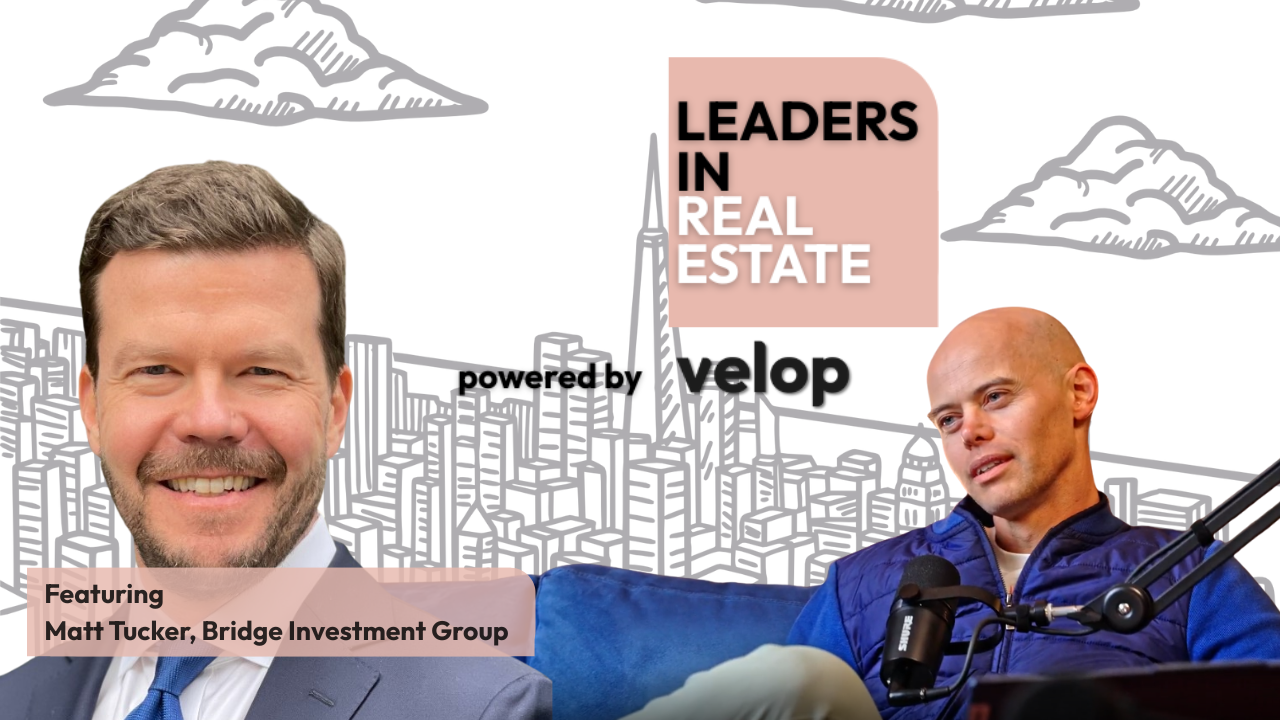
In this episode of Leaders in Real Estate, Velop founder Nick Carman talks to Matt Tucker, CEO and Co-CIO of Bridge Net Lease at Bridge Investment Group and a three-time NCAA lacrosse champion at Princeton. Matt explains how athletics built his grit, how he learned to trust a team, and what producers must unlearn to become leaders.
Key takeaways
- Keep a short memory for pain. Learn from a loss, then come into the next game with a fresh, positive attitude instead of dwelling on mistakes.
- Grit is the foundation. Balancing Division I lacrosse with Princeton's academics taught Matt persistence and work ethic, and he believes grit can be developed.
- Stay hungry. At least once a month he asks: if a hot shot came in and wanted my job, what would I need to improve today?
- Balance offense and defense. Strong investors are aggressive when they like an opportunity, but never put "blinders on" to risks found in due diligence.
- You never fully let go. Leaders build teams they trust, hold them accountable and stay on top of the details.
- Building is more than investing. A builder creates the team, the processes and new investment structures, not just the next deal.
- Hire for competence and grit. Real estate "is not rocket science." Know your tools, then show up every day and do the work.
- The best deal can be no deal. Producers paid to do deals have to learn that saying no is sometimes the right decision.
- Don't overpromise. His most painful mistake was having to walk back a commitment to a good relationship.
About Matt Tucker
Matt Tucker is CEO and Co-CIO of Bridge Net Lease and a Senior Managing Director of Bridge Investment Group. He co-founded the net lease vertical with partner Brandon Flickinger when they joined Bridge in 2021, and leads strategy, investor relations and the investment committee for a strategy focused on long-term leases to creditworthy tenants, with a significant industrial component. Earlier in his career he worked at Gladstone Commercial, JP Morgan and Liquid Realty Partners. Matt grew up in the Detroit area and graduated from Princeton, where he won three NCAA lacrosse championships under coach Bill Tierney.
In this episode
- 00:00 Cold open: "A short memory for pain"
- 00:47 Introducing Matt Tucker, CEO, Bridge Net Lease
- 01:42 Detroit roots, real estate at home and Princeton lacrosse
- 04:11 His role at Bridge Net Lease
- 05:20 What Princeton taught him: grit
- 10:23 Offense or defense in today's real estate market?
- 12:58 First leadership role, and learning to let go
- 15:42 "Not just an investor, a builder"
- 18:33 The traits he looks for: competence and grit
- 20:48 Can grit be learned?
- 21:49 His why: family
- 23:03 Good and bad drivers: when the best deal is no deal
- 24:29 The one book he gives teammates: Principles by Ray Dalio
- 26:45 Rapid fire: leadership, delegation and his most painful mistake
- 28:07 How to know when to stay and when to move on
- 29:27 Wrap
Questions answered in this episode
How did playing sport shape Matt Tucker as a leader?
At Princeton, Matt went from high school star to "supporting cast player" under a demanding coach, while handling a highly competitive academic environment. He says the biggest lesson was grit: persistence, working through hard moments, and always looking to improve.
Should real estate investors be aggressive or defensive today?
Both. Matt says the groups that came through the downturn after 2021 balanced putting money to work with not "getting over their skis." His net lease strategy is income-oriented and defensive by design, but the team gets aggressive when they find the right opportunity.
What does Matt Tucker look for in emerging leaders?
Competence first: analytical skills, market knowledge and research. Then grit: showing up every day, picking up the phone, and being able to make and communicate hard decisions. He values being in the office early and together, so junior people learn from senior ones.
What is the hardest part of moving from producer to leader?
Accepting that you might have to say no to a deal to be successful. Matt warns that the worst deals happen when producers try to sell the investment committee instead of having a disciplined debate about the merits.
What book does Matt Tucker recommend?
Principles by Ray Dalio, the only book he has ever given to teammates or partners. Its ideas on radical transparency and getting smart people with different views in a room helped him put ego aside and get to the best answers.
How do you know when it's time to leave a company?
Matt moved on when he could no longer progress or his goals differed from the company's. But he urges patience: "It always seems like there may be greener pastures," and real estate is a small business where it's hard to go back.
Notable quotes
"Have a reasonably short memory for pain." (00:00)
"Real estate is an engaging and challenging business, but it's not rocket science." (18:53)
"Leadership is walking the walk." (26:59)
About the host and Velop
Leaders in Real Estate is hosted by Nick Carman, founder of Velop, a real estate executive search firm for investors and developers in the US. Velop uses personality and cognitive assessments at the start of every search so clients can judge culture fit and potential before the shortlist. Contact Velop
Full transcript
[00:00] Cold open: “A short memory for pain”
Matt: One thing I learned as an athlete, or a sportsman as you say, is to have a reasonably short memory for pain. That’s not to say you don’t acknowledge your mistakes and learn from them, but you don’t want to dwell on them. If you lose a game, you want to learn from it, take those lessons and apply them to the next game, but come in with a fresh, positive attitude, not worrying about what you screwed up last time.
[00:47] Introducing Matt Tucker, CEO, Bridge Net Lease
Nick: Welcome to the Leaders in Real Estate podcast. I’m your host, Nick Carman, and I hope this podcast proves to be your mentor in your pocket. We’re going to talk about the challenges, obstacles and benefits of leadership through the lens of today’s guest.
Today I’m joined by Matt Tucker, CEO and Co-CIO of Bridge Net Lease at Bridge Investment Group. Matt has spent his career leading billions in real estate investment, building teams and co-founding new verticals within Bridge. Before that he was with Gladstone Commercial, JP Morgan, SG Capital and Liquid Realty Partners. He’s a Princeton alum, a three-time NCAA lacrosse champion, and someone colleagues and teammates consistently describe as a quietly confident, empowering leader. Matt, thanks very much for joining us.
Matt: Nick, it’s great to be here, and thanks for inviting me on.
[01:42] Detroit roots, real estate at home and Princeton lacrosse
Nick: The pleasure is all mine. Let’s get started, shall we? Let’s wind the clock back. Tell us a little about your background, Matt. Where did it all begin?
Matt: Sure. I grew up in the Detroit area in the Midwest, and Detroit is the Motor City. When I was a kid, my friends’ parents did one of three things: they worked for the Big Three automotive companies, or… my dad was a lawyer, so I knew what that was all about. My mom sold real estate. She was a real estate agent. And I played sports and got banged up a few times, so I knew about doctors. I didn’t have a big, broad view of the world.
But I rode around in the back seat of my mom’s car while she showed houses, and part of what she did throughout my upbringing, and my twin sister’s, was lead the buying, renovating and flipping of homes. We always lived in those homes, so I kind of lived on a construction site and always had an interest in real estate.
As already noted, I also played a lot of sports, so a team environment is really familiar to me. Whether it’s the middle of an intense game or the locker room having fun with my friends, team environments are where I feel most comfortable.
As I came through high school and looked at where to go next, I had the opportunity to go to Princeton. I’d been a high school All-American lacrosse player and was recruited by a number of schools. When I told my mom Princeton was interested, she said, “If that works out, you’re going to Princeton, because it’s the best school on the list.” And coincidentally, in 1992, the year before I was choosing a school, Princeton had won its first national championship in lacrosse in the modern era. So it was a bit of a no-brainer to choose Princeton. I was really fortunate that Bill Tierney, the coach there, found me in Michigan, which wasn’t a big lacrosse environment compared with some of the East Coast cities, where it was a big sport at the time. So I landed at Princeton in the fall of 1993 and started my journey as an adult from there.
[04:11] His role at Bridge Net Lease
Nick: We’ll dive into what has affected your career and probably shaped Matt Tucker the leader. But let’s take a moment to establish what you’re responsible for now at Bridge.
Matt: Sure. At Bridge Investment Group, I’m a Senior Managing Director, and I run the Bridge Net Lease vertical with my partner Brandon Flickinger. I’m the CEO, and Brandon and I are co-CIOs. We set investment strategy for the vertical, lead the investment committee and lead our team together. As CEO, I take more of a role in strategy, investor relations and investor communications. So it’s everything from building the team to reviewing and approving the investments our team makes, staying on top of our portfolio, talking to investors about the merits of investing in our strategy, and then investing that capital wisely and being a good steward of those dollars over the long term.
[05:20] What Princeton taught him: grit
Nick: Interesting. Really interesting. Let’s dive into your background a little and put together a few more of the steps on that career path. People who listen to this series know we like to do a bit of digging. I managed to speak to one of your fellow Princeton alumni, someone who knew you very well at the time and was on the same lacrosse team. I asked them to shed a little light on who Matt was. They explained that you were clearly an excellent sportsman, and you went on to win three incredible national championships. But despite that natural talent, they said it wasn’t all plain sailing. While this is a real estate pod rather than a sporting pod, I thought it would be worth touching on, to see how that shaped you as an individual and whether it’s played a part in your leadership style today.
Matt: That’s a great question, Nick. My teammate and friend who you spoke with and I had a similar experience. We’d both had a lot of success as athletes before getting to Princeton, and as you noted, we had great success while there. But we were coming in as freshmen, and our classmates and teammates were also among the best players in the country at the time. So we immediately jumped into a healthy, natural competition with each other that has developed into a brotherhood we still carry today. I’m sure that before we finish recording this podcast, I’ll have half a dozen texts from the guys in my class who all arrived in Princeton, New Jersey, together as 18-year-olds.
Our coach, Bill Tierney, is still considered one of the legends of lacrosse coaching. Coach T, as we called him, was a tough coach. I think his coaching style evolved over the years, but when we were there, it was tough love 24/7, and he held us to a very high standard. I’d had a very positive, offensively minded high school coach, and Coach Tierney was certainly hard on his players and played a very defensive game. So I had to learn to fit into a new system, and to be more of a supporting-cast player than the star of the team.
As a young adult, I also had to learn to balance Division I sports, a three-, four- or five-hour-a-day commitment all year round, with Princeton’s highly rigorous academics. As I said before, I knew of just a few professions I could potentially go into, so I entered Princeton on the premed track. Princeton grades on a curve. I was in freshman chemistry with about 200 other kids, and I think my final grade was 87%. At Princeton, that’s a C on the curve. So I had to wake up pretty quickly to a really competitive environment, not only in sport but academically.
I think that level of intensity has really shaped my work ethic today. I’d characterize it as grittiness. I think developing grit is really important for success in any business or line of work. You have to be persistent. You have to work through challenges, through the times when it’s hard, and when it’s cold outside in the spring and you’re soaking wet in five-year-old heavy sweatpants issued by the athletic department, not the modern athletic gear everybody has today. That’s a tough environment. Then you have to get off the field, eat dinner and go study for a couple of hours. So it was rigorous and challenging. We had a heck of a lot of fun and a lot of success. But the biggest thing I took from Princeton, as an athlete and as a student, was developing that grit and work ethic.
I’ve carried with me this idea that you always have to improve if you want to succeed in whatever you’re doing. At some regular interval, at least once a month for me, you have to ask: what if some hot shot came in and wanted my job? What do I need to improve today so I’m at the head of the pack and can do what I’m doing better than the best people out in the world? I take that from my experience at Princeton.
[10:23] Offense or defense in today’s real estate market?
Nick: Very quickly, then, Matt, given those two coaches’ differing philosophies: what works better in real estate today, defense or offense?
Matt: I think you have to have a balanced strategy. The real estate world was very exciting until the end of 2021. We had a long and very fruitful run while interest rates came down, and it was an easy environment to be aggressive and offensive. As we moved past the peak of the market, I think the groups that have succeeded through this more challenging period have balanced being aggressive and putting money to work with being defensive and not getting over their skis.
The way that’s been helpful for us is that when we joined Bridge, our timing was good. We joined in 2021 and really began executing the strategy in the second half of that year. We’ve been investing through what’s been a bit of a down cycle, as pricing fell and then stabilized and fundamentals weakened a bit. Now we’re in an environment where we see opportunity. With the Fed cutting rates in the US, and pricing and fundamentals having stabilized, there’s opportunity. At the same time we have trade war uncertainty, and we invest a lot in the industrial sector, so we have to balance the desire to grow and be aggressive with keeping a defensive posture.
The net lease strategy I help run is really an income-oriented, somewhat defensive strategy that should perform in good markets and bad, because you have long-term leases with creditworthy tenants. When we like an opportunity, we get aggressive and try to win it. But at the same time we have to be defensive: underwrite the opportunity well, do our due diligence thoroughly, and have an open conversation when we run into risks. Where you get into trouble by being overly aggressive is when you put your blinders on to risks you uncover in due diligence because you want to grow. So I really think you have to balance both sides.
[12:58] First leadership role, and learning to let go
Nick: Okay. Let’s get into the second chapter and talk about your journey into leadership. When did you first get the chance to really lead people in your career?
Matt: Fairly early in my career I had the opportunity to lead small teams, but just teams of one or two people, and I tried to provide clear guidance and clear expectations.
Nick: Did you feel ready?
Matt: I’m not sure anybody’s fully ready the first time they’re given leadership responsibility. Taking on leadership is a challenge for a lot of producers who are narrowly focused on their personal goals. That transition is tricky for a lot of people. It didn’t come naturally to me at first, but some of my experiences helped along the way.
Nick: From my own experience, and from listening to your peers when I’ve been privileged to be in this position, I think leadership often starts with the realization: “I can’t do this on my own. I now need others’ help.” That in itself is a key difference, a gear change from what got you to this point to what will get you to the next. So I’d like to know, Matt: how easy is it to let go? You’re the Matt who’s crushing it in his team, and you get the tap on the shoulder: “Right, you’re now ready for leadership.” How quickly or easily did you learn to let go?
Matt: I think that’s a process, and the way I’ve learned to let go is by building a team I can trust. It’s a two-way street. You have to have people you can rely on and trust, and you have to hold those people accountable. I’m not sure “letting go” is the right term. You have to trust, and then hold people to account for the goals you set for them. It’s a different kind of work from being a producer, where you’re self-driven, pushing forward for yourself and relying on yourself all the time. But I don’t think a leader can really let go. You have to be on top of the details, while trusting the people working for you to deliver.
[15:42] “Not just an investor, a builder”
Nick: I agree. In the producer phase of their career, an individual can get away with being pretty selfish, sometimes not the best teammate. But the gears and the pressures really change when you get into leadership. That’s probably a nice segue to bring in a little more of our research. I spoke to your co-CIO, Brandon, and asked him about who Matt is and his style. I’ll quote him, because he describes you like this: “Matt is not just an investor. He’s a builder.” He said co-founding the net lease vertical and bringing innovation to what is quite a conservative space was really innovative. I’d like to spend a little time unpicking that. What is the difference in what you and your team are doing today? Give me a flavor of it.
Matt: I think what Brandon is referring to is that I’ve always been interested in building a business I have real ownership in, and we had that opportunity when we joined Bridge as partners. The investing part Brandon refers to is the day-to-day deal work, which I’ve always found very interesting and engaging. Tying back to the theme I mentioned of doing things you’re naturally inclined to do, it’s very project-oriented. You identify a property, go through bidding, due diligence and closing, and then in a lot of cases you move on to the next one.
Building is the full process of building a business. In our case, that means making those investments, but it also means building the team. It means putting processes in place so you have good management tools, so you can hold the people you trust and put in the field accountable. It means looking for new and innovative structures for investment vehicles. In my partnership with Brandon, I focus a lot on that: how can we improve our processes? How can we find new opportunities with investors? How can we apply the expertise we’ve built over a long period, investing in what a lot of people think of as a pretty vanilla asset class, long-term leased assets to creditworthy businesses, in a slightly different way, so we can make a bit more for our investors while taking, we think, a bit less risk?
So we look for opportunities to expand buildings, or where we might have the chance to do some development projects. These are a little outside the box in the net lease space, and it’s served us well with the portfolio we’ve built. We’ll always keep an eye on being creative and pushing forward.
[18:33] The traits he looks for: competence and grit
Nick: Okay. Whether internally or externally, Matt, what do you think is the number one trait you look for when you’re considering emerging leaders today?
Matt: What I’m mostly looking for is competence: having the skills, and grit. Real estate is an engaging and challenging business, but it’s not rocket science. It requires, first and foremost, competence in the skills: understanding your analytical tools, markets and research. But more than anything, it’s getting out of bed, showing up every day, doing the work, picking up the phone and calling people, and having the discipline to keep going every day. That may sound very mundane, but I think it’s really important to just show up and get the work done.
As a young person, one way to communicate upward is to do exactly that. Get to work before your boss, and send those physical messages, by being there in person, that you’re there to get the work done. Then, as a leader, do the same thing. I try to be in the office early. In today’s post-COVID environment, where a lot of people work from home, I’m grateful our team has a culture of working in the office together, because I think we communicate better. We see each other. We have a Friday lunch every week, and it gives us the opportunity to be together so junior people can learn from senior people.
So as I look for emerging leaders, it’s, first and foremost, do they have the basic skills, and then can they hold people accountable for executing them? And second, do they have the grit to show up every day and make and communicate hard decisions? That’s an evolution you can observe. Some people get through to the other side, and some people have challenges doing that.
[20:48] Can grit be learned?
Nick: We’ve talked a bit about grit. Is it something you can learn? If anyone listening is thinking, “I’m not sure that’s one of my strengths,” what’s your advice to them?
Matt: I think it’s something you can develop. Some people are naturally built with grit in their DNA, but I also think you can teach yourself grit. The way I think about it is that I have personal goals, family goals and things like that, and I think about what I need to do to get there. Grit is a big part of that. Whenever you’re tempted to take a little break in the middle of the day, or your focus wanders, it’s the discipline to get back into it and keep pushing forward.
Nick: I agree with that. I think recognizing why you’re doing something is incredibly important as well.
Matt: Yes. Absolutely.
[21:49] His why: family
Nick: So on that: what’s your why, Matt? What drives you?
Matt: My why is my family. I just celebrated 20 years with my wife, shortly after celebrating my 50th birthday, so this is a nice time to reflect on the why. I have two kids, and I have great relationships with my parents. My wife sadly lost her father. Having good bonds with my family, and the opportunity to share experiences until I’m an old person, is really what drives me. Not money, not title. Well, you need the financial resources and wherewithal to do what I just described.
Nick: I did warn you HR might be listening. This is completely voluntary.
Matt: No, not at all. That’s a big part of it. To meet those goals, I have the personal ambition to do well in my career, and doing well means making some money.
[23:03] Good and bad drivers: when the best deal is no deal
Nick: Do you think there are good and bad drivers? Again, thinking about our audience, who are a little younger, frankly have less money and are lower on the career ladder: are there positive and negative drivers?
Matt: I do, and it’s something my partner Brandon and I talk about a lot. A lot of successful producers are very financially driven, and that’s why those financial incentives are in place. But the worst deals you can do are the ones where your producers are trying to sell the investment committee on a deal, rather than having a good, disciplined debate about its merits. As a leader managing producers, you really have to watch out for that.
And one of the hardest things about transitioning from producer to leader is reconciling that you might have to not do a deal to be successful. You might have to say no and forgo that immediate reward. If your compensation structure rewards you for doing deals, the best decision might still be to say no, and that’s hard. I think it’s one of the hardest things producers need to learn to make the jump to leadership, where you have real responsibility for the outcomes.
[24:29] The one book he gives teammates: Principles by Ray Dalio
Nick: Okay. Sticking with mentoring: for someone listening now, what would you suggest is the best resource or book? Obviously we know the best podcast series. But what should they go out and pick up to develop some of the skills we’ve touched on today?
Matt: First and foremost, read a lot and listen to a lot of podcasts. There’s so much good content out there on the business world generally and on real estate specifically. Try to listen to a lot of different things, so you get different points of view, take them in and develop your own point of view, because that’s what will be really valuable. If you end up in an echo chamber, you’re not bringing anything new to the table. So take in as much as you can.
To get specific, the only book I’ve ever given to teammates or partners is Principles by Ray Dalio. I downloaded the PDF of Principles from the Bridgewater website a long time ago, before it was published as an actual book. A few things in Ray Dalio’s guidance really struck me. One is radical transparency. I think about it as finding out what the truth is, which means you have to be clear-headed. You have to get the right group of people in the room and cut through the noise to get to what’s really happening, and different motivations, compensation structures and all that can get in the way.
The other part, which dovetails with that, is getting to the right answers. By being transparent and truthful, by saying “I don’t know” when you don’t know, and by getting in a room with a bunch of other smart people with different points of view, you can get to the best answers. If you put your ego aside and stay open to the input of other smart people, I think you end up getting to the best answers. There’s a lot of other good content in there, but those are the two things I really took away from the book.
[26:45] Rapid fire: leadership, delegation and his most painful mistake
Nick: Okay, let’s change things up. As we approach the last couple of minutes, let’s get some machine-gun-style answers, Matt, to squeeze as much as we can out of this mentoring session. Leadership: finish this sentence.
Matt: Leadership is walking the walk.
Nick: Interesting. What’s one aspect of leadership you’ve struggled with the most?
Matt: Delegation, and relinquishing day-to-day control over the work. As I talked about earlier, it’s developing trust in the people doing the work day to day.
Nick: I get that: captaining the boat and being the cook as well. Your most painful mistake, and what you learned from it?
Matt: I’ll spare the specifics, but it’s overpromising to a good relationship and then having to walk something back. That’s a painful experience. My lesson for people is to make sure you’re clear on everything supporting your decisions and what you’re communicating to your good relationships. It’s a relationship business, and having to walk something back or change course after you’ve communicated it is pretty painful.
[28:07] How to know when to stay and when to move on
Nick: Okay, last question, and it might be one of the most important. In the introduction I let the audience know who you’ve worked for. There are some big brands and big organizations there, and ultimately you decided the time was right to move on. How does someone in the audience know when it’s time to show grit and knuckle down, and when it’s time to cut?
Matt: That’s a great question. I’ve spent time at a lot of great companies, and I looked to leave when I could no longer progress, or when my goals were different from the company’s goals, and you have to make a hard decision. But my advice would be to be very patient and very thoughtful about leaving a company for a new one. It always seems like there may be greener pastures, but real estate is a reasonably small business made up of a lot of small teams, and you never really know what you’re getting into until you’ve spent a lot of time with those people. So be very thoughtful about changing, because it’s hard to go back once you’ve made a change.
[29:27] Wrap
Nick: Right, Matt, we’ve got to bring this to a close. Thank you very much for joining me. And to anyone in the audience listening now, make sure you click like and subscribe, and add in the comments any questions you’d like to put to Matt, or to our future guests. Matt, thank you very much again for giving up your time for this. I’ve really enjoyed it.
Matt: Thanks, Nick. Thanks for inviting me.
Published October 27, 2025. At the time of recording (September 2025), Matt Tucker was CEO and Co-CIO of Bridge Net Lease at Bridge Investment Group.