
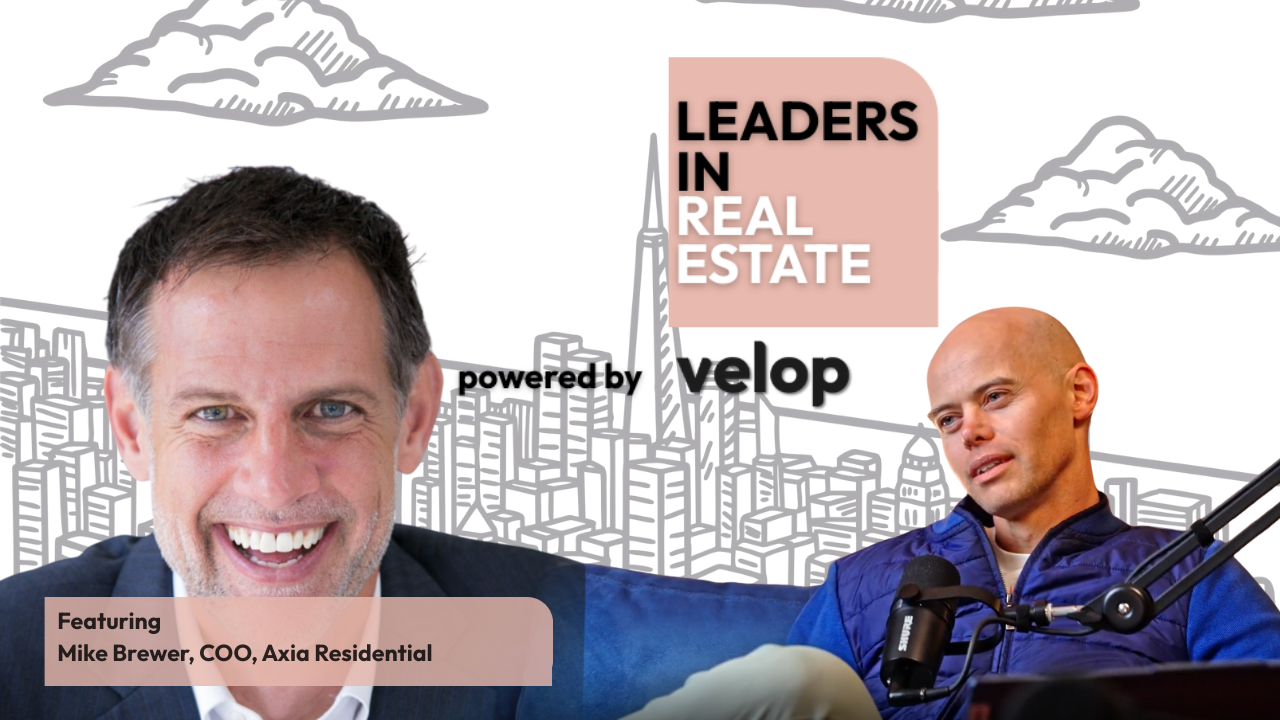
In this episode of Leaders in Real Estate, Velop founder Nick Carman talks to Mike Brewer, COO of Axia Residential at ARC Multifamily Group, founder of the Multifamily Media Network and former COO of RADCO. Mike explains how new leaders learn to get things done through others, why consistency beats adapting, and what he looks for in the next generation.
Key takeaways
- Leadership means getting things done through other people. That requires delegation, delegation requires trust, and trust comes from understanding what inspires people, not just what motivates them.
- Learn the business at every level. Mike went from leasing consultant to assistant manager, property manager and district manager. Knowing every seat means you can tell when work is done right and coach people through the reps.
- Vision needs action and timing. Mike's predictions sometimes arrive later than he says they will, and he's learned that unfulfilled vision can look like "pie in the sky thinking."
- Rebuild confidence before rebuilding the plan. When someone fails, help them look back at what they've already achieved, then put "pure definition" on the problem and build a new plan.
- Be consistent. Lead people the way they want to be led, but never at the cost of your own values. If you're a different person every day, your team is exhausted trying to work you out.
- Look for curiosity, humility and kindness. Mike will "pour a lot of time and money" into young leaders who ask a thousand questions and know they have to do the reps.
- Command-and-control has a place, but it causes fatigue. It works in a real crisis. Over time, a humble, kind style produces better outcomes.
- Lead with purpose. Define who you want to be, break it into values, and live by them in service of others.
About Mike Brewer
Mike Brewer is Chief Operating Officer of Axia Residential, the property management company of ARC Multifamily Group, and founder of the Multifamily Media Network. Over three decades in multifamily he rose from leasing consultant through assistant manager, property manager and district manager roles to become COO of RADCO, which sold around $3 billion of assets in 2019 and 2020. He has written and broadcast as the Multifamily Collective for nearly two decades, from blogging to podcasting and video. He started his career running his own lawn care business.
In this episode
- 00:00 Introducing Mike Brewer
- 01:23 What he's working on today
- 02:28 The hardest transition: getting things done through other people
- 04:30 His first attempt at leadership: the Lawn Ranger
- 05:24 Learning multifamily from the leasing office up
- 06:35 "He is a visionary": when foresight gets you in trouble
- 08:45 How to keep going after a knock
- 10:47 Helping a leader rebuild after failure: the gap and the gain
- 13:06 Authentic or adaptable? How to lead different personalities
- 15:36 Has leadership changed? Five generations and AI
- 17:00 What to read: Peter Drucker and Tom Peters
- 18:27 The traits he looks for: curiosity, humility and kindness
- 19:46 Does command-and-control leadership work?
- 21:32 What drives him
- 22:43 Good and bad drivers: a purpose in service of others
- 24:27 The next multifamily cycle: technology plus human
- 27:28 "Business exists to serve the people who serve it"
- 29:09 Wrap
Questions answered in this episode
What is the hardest part of becoming a leader?
Mike says it's the shift from doing things to getting things done through other people. You have to accept you can't do it all and delegate, which means building deep trust with the people you lead and understanding what inspires them in life as well as at work.
How do you help someone recover from their first failure as a leader?
Mike draws on Dan Sullivan's idea of the gap and the gain. First, help them look back at everything they've accomplished so their confidence returns. Then put "pure definition" on the problem: where the weakness was, where the gains could be, and a plan to rebuild it their way.
Should leaders be authentic or adapt to their team?
Authentic, says Mike, while still leading people the way they want to be led. "If I'm a different person today than I am tomorrow," the people he leads are "mentally fatigued" trying to work him out. Know your values, show them every day, and apologize quickly when you slip.
What does Mike Brewer look for in young leaders?
Curiosity first, "no matter how silly" the questions sound. Then humility and vulnerability, which he says are increasingly rare, and kindness. Someone who isn't full of themselves and knows they have to do the hard work is someone he'll invest in.
What books does Mike Brewer recommend?
He starts with wisdom literature, then the business thinkers he set out to emulate, especially Peter Drucker, "my hero as it relates to business," and Tom Peters. Podcasts are useful, but he believes nothing beats long-form reading with a highlighter and notes in the margin.
Notable quotes
"Motivation and inspiration are two very different things." (04:08)
"It is a privilege, an absolute honor to lead other people." (28:29)
"Business is created to serve the people that serve it." (paraphrasing Peter Drucker, 27:59)
About the host and Velop
Leaders in Real Estate is hosted by Nick Carman, founder of Velop, a real estate executive search firm for investors and developers in the US. Velop uses personality and cognitive assessments at the start of every search so clients can judge culture fit and potential before the shortlist. Contact Velop
Full transcript
[00:00] Introducing Mike Brewer
Nick: Welcome back to the Leaders in Real Estate podcast. I’m your host, Nick Carman, and today we’ve got an absolute cracker of an episode. We’re building a series of mentors in your pocket, intended to unlock your career as a future leader. They share the challenges they faced, the lessons they learned and their successes, to help you build your own toolkit for leadership success.
Today I’m joined by Mike Brewer, a legend in the multifamily market. He has 30 years of experience, most recently culminating in the Chief Operating Officer role at RADCO, which famously timed the market in disposing of $3 billion of assets between 2019 and 2020. Today Mike runs not one company but several. He runs the Multifamily Collective, and he’s COO for ARC Multifamily Group, a new name in the multifamily community. It’s quite amazing he’s managed to find time for us today. Mike, thank you very much for joining us.
Mike: Nick, thank you for having me on. I really appreciate it.
[01:23] What he’s working on today
Nick: The pleasure is all mine. Let’s get started. Tell us what you’re involved in today, Mike.
Mike: The last four or five years, let’s say post-COVID, have been really eventful. I left RADCO about three years ago, give or take. When I left, it was an exit from the corporate world I’d been in for 28 or 29 years at that point, and I decided to start a media network. The Multifamily Media Network is a company we created around the middle of COVID. The Multifamily Collective is something I’ve been doing for 18 or 19 years, since blogs became a thing, and it evolved into podcasting and video podcasting. Then about nine months ago, give or take, in March, I joined ARC Multifamily Group as COO of their property management side, which is Axia Residential. So today I’m Chief Operating Officer of Axia Residential, in addition to running the Multifamily Media Network.
Nick: That’s quite a schedule.
[02:28] The hardest transition: getting things done through other people
Nick: Most of our audience are future leaders. I think of them as associates and senior associates up to VPs. Frankly, I feel a bit sorry for them, because they’re either approaching or right in the middle of what is, without doubt, the hardest challenge they’re likely to face in their career: the transition from solo producer, the shining star in a team, to suddenly having to lead teams. They’re realizing that the skills that got them here won’t take them further. They need a completely different toolkit. So let’s start by winding the clock back. Do you remember being in those shoes, in those very early days of leadership? What were some of the challenges you faced?
Mike: I think you identified one in your lead-in. It really is making the transition from doing things to getting things done through other people. The hardest transition is understanding that you can’t do it all, and that you have to delegate. To delegate, you have to create a great basis of trust with the people you’re tasked with, or privileged with, leading. That takes a really deep dive into building relationships, not just in the business world, understanding the outcomes we have to create, but personally too.
To the extent a person can take a deep dive into understanding who people are innately, and what inspires them… motivation and inspiration are two very different things. What inspires them in their life? Then, how can you align that with business, and leverage what inspires them in life to inspire outcomes at work? If you can align those two things, that’s a great start to getting things done through other people.
[04:30] His first attempt at leadership: the Lawn Ranger
Nick: I think that’s a very good description. Let’s carry on in that vein and take a deeper dive into leadership. When was your first opportunity to lead, Mike?
Mike: I actually started out as a solopreneur. In the early 90s I started a landscaping company called the Lawn Ranger and began cutting grass in my local neighborhood. About nine to 12 months into my solopreneurship, I couldn’t handle the volume anymore, so I hired my first employee. That was my first effort at getting things done through other people, and if I’m honest, it was a complete disaster, because I gave that person no direction. I didn’t teach him how to cut grass. I didn’t teach him how to blow the grass off the driveway at the end. I just got very frustrated all the time and couldn’t really articulate my expectations.
[05:24] Learning multifamily from the leasing office up
Mike: If I fast-forward to the multifamily space, my first step was becoming a leasing consultant. This is important, because it helped me learn the multifamily business from the entry level. I understood how to lease and sell apartments. Then I became an assistant manager, where I learned some of the more task-oriented things like accounting, entering rent and paying bills, before I became a property manager, then a district manager, and so on.
I think it’s fundamental for any leader to understand the business at every level before trying to lead it, for two main reasons. First, when someone tells you something is done, or was done, you can tell whether it was done right, because you’ve been in that seat. You’re not tricked as often, if you will. Second, you can help people truly understand the reps needed to become good at being a leasing person, an assistant manager, a property manager and, ultimately, a leader.
[06:35] “He is a visionary”: when foresight gets you in trouble
Nick: That’s a nice segue, Mike. You’ll know we like to do some digging on our guests. I spoke to a couple of people who know you very well, and they were very generous with their time in giving me a good overview of who Mike is and what type of leader he is. So I’d like to dive into that a little. This is how one of those people described you. Are you ready? Sitting comfortably?
Mike: I’m a little nervous.
Nick: Exactly where we want you to be. “Mike is unlike anyone else I have worked with. He is a visionary.” She goes on to say a lot more, and we might come back to that. But that word, visionary, isn’t one you hear a great deal in real estate. And in history, visionaries have mixed fortunes, don’t they? They don’t just need great ideas. They need to time them really well. So has that trait ever got you into trouble?
Mike: The short answer is yes. Where it has landed me in hot water, and where it still certainly does, is that I have a keen sense of what’s going to happen five or ten years out. That’s not to suggest it’s what actually happens, but I certainly have a sense of what the outcome will be five to ten years from now. I tend to articulate that, opine on it and put it out into the world, and then the world doesn’t move as fast as I think, or thought, it would.
So I build these expectations in, say, owners, asset managers or other people in the real estate business, and when those things don’t come to be, you get looked at like, “You were just pie-in-the-sky thinking. There was no real action behind an outcome related to that vision.” That’s probably the biggest hindrance of being a visionary.
[08:45] How to keep going after a knock
Nick: What gives you the confidence to try again? Thinking about our audience, some of them might be lucky enough to share some of that foresight. They might have the best idea, but with poor timing they take a knock. What’s your advice to them on finding the confidence to give it another go?
Mike: I’ll tell you what has worked, and works, for me. I’m a student of the world. I look at the world as one great big education, and if I’m not waking up, participating and doing the reps in the world, it’s like dying a slow death. I get confidence from the fact that people who came before me, people much smarter and more adept at business and the world, failed or created visions that didn’t come true. They got up, dusted themselves off, took the lessons from those moments of maybe saying too much, applied them, and kept trudging down the path to create an outcome.
I think that creates a resiliency in you. And when you eventually see something come to be that you talked about three, four or five years ago, that adds to the resiliency as a data point to keep going. I have a hard time articulating this, but I’m very disciplined about waking up every day, feeding my brain and going out into the world to apply what I learn. I just don’t think about failure or embarrassment too much, because in my head it would discount me and make me feel unmotivated. So I try not to think about it, and I just keep going.
[10:47] Helping a leader rebuild after failure: the gap and the gain
Nick: That “keep going” sparks a conversation I had with another of your colleagues, someone who reported to you. She told a really good story about going through her first failure as a leader. The team wasn’t up to it, and she had to cycle through the whole team and start all over again. She said you helped pick her back up. How does Mike do that? We’ve talked about your own confidence. How do you inspire confidence in other people? That sounds like really powerful stuff, Mike.
Mike: There’s a concept, and I hope I articulate it well. I think it was Dan Sullivan who wrote a book called The Gap and the Gain, and I may mix things up, so apologies in advance. In a circumstance like that, you have to sit people down and help them look back at the accomplishments they’ve had in their life up to that point. Sometimes those things are very elementary. Sometimes they’re more important or groundbreaking. But that person, like you and me and others, has accomplished a lot in their life, and sometimes you just have to look in the rearview mirror and see all of it, so you can replant that confidence.
The other thing you have to do in a situation like that is put pure definition to the issue you’re facing. You look at everything you’ve done in the past and get confidence. Then you sit down, do a reality check and define the issue in front of you. You understand where the weakness was and where the potential gains will be, because when you get a chance to rebuild something, you can do it under your own architecture. You see success, you define the problem, and then you can create real plans to put into play and reach the outcome you want. It’s really a kind of visioning: picturing what you want to create, then putting the pieces in place to create it.
[13:06] Authentic or adaptable? How to lead different personalities
Nick: Let’s go into our third chapter now, Mike: our deep-dive, one-on-one mentoring session. I’m going to give you two statements, and you tell me which one you subscribe to. Leaders need to be authentic, consistent and genuine. Or leaders need to adapt to suit the personalities of their team, or the moment.
Mike: Without a doubt, the first one resonates with me most.
Nick: The authentic, consistent, genuine one. Again, for someone with less experience, someone new to leading a team: how do they get the most out of teams that are, chances are, made up of completely different characters and personalities, who probably want different things from their leader, while still staying authentic and genuine to themselves?
Mike: It’s interesting, because I’m having a “two things can be true” moment in my head. The word chameleon comes to mind, and you do have to manage and lead people in the way they want to be led. But you can’t do that by sacrificing your own consistency and authenticity. In my head, I have to be true to myself and have a true north, because the people I’m leading will look at me and see that as a guidepost. If I’m all over the place, a different person today than tomorrow and the day after, that person gets mentally fatigued trying to figure out who Mike is, what he’s about and what he’s doing.
Whereas if I show up the same every day, true to myself, full of integrity and character, that person has a bellwether, if you will: something they can aspire to and look to without question. Anybody coming up in leadership has to understand what their personal values are and demonstrate them every day. You’ll screw it up every now and then, so you have to be very quick to apologize and acknowledge when you mess up, and get back to that true north. I’d encourage that, and that’s how you inspire other people to do the same.
[15:36] Has leadership changed? Five generations and AI
Nick: What about leadership today? Has the concept of being a leader changed over time, do you think? Is it different for someone in their mid-to-late 20s embarking on that stage of their career now?
Mike: I don’t think leadership in its essence has changed. To me, leadership is inspiring others to show up and be a better version of themselves than they were yesterday, and having good character for them to look to. That’s the essence of it. What has changed, and what leaders have to adapt to, is this: you have five generations in the workplace today, and you have to figure out how to get them working together for good outcomes. And technology has entered the workplace in a way that… I think we’re all in the wild west right now with artificial intelligence and the other things affecting the workplace.
So leaders have to be quick on their feet. They have to be agile in their thinking, in constant learning mode, and doing the reps: not just reading about the things coming into the workplace that affect outcomes, but being practitioners of them. At its core, leadership is no different, but all the pressures on leaders, upstream and downstream, are very different. You just have to be very agile today.
[17:00] What to read: Peter Drucker and Tom Peters
Nick: You mentioned reading. I’ve listened to several of your podcasts and watched several of your videos, and clearly, Mike, you’re very well read. For someone in the earlier part of their career, what’s one resource, one book or piece of content, they should be soaking up right now?
Mike: For me personally, everything starts with wisdom literature, and the Bible is always my go-to for that. As it relates to leadership itself, I picked Peter Drucker, Tom Peters and some of the great entrepreneurs over time as people I wanted to emulate, or at least take pieces of their character to apply. Drucker is probably my hero when it comes to business.
For any aspiring leader, I think podcasts are incredibly important, because you get all these tidbits, and blogs are great. But long-form reading in book form, sitting down and actually going through the pages, highlighting, taking notes and writing marginalia… in my opinion there’s no equivalent for gaining knowledge you can apply on your leadership journey.
[18:27] The traits he looks for: curiosity, humility and kindness
Nick: What about when you’re sitting across from one of these young leaders, maybe interviewing them or meeting them at a networking event? What traits do you look for? What are the clues that suggest they’re going to be great?
Mike: First and foremost, curiosity. I really enjoy young leaders who ask a thousand questions, no matter how nuanced, and no matter how silly they might sound coming out of their mouth. I think curiosity is the lead-in to all great leadership.
Then a willingness to be humble, which seems to be a character trait that’s becoming rarer and rarer. Being vulnerable and humble in all moments. And kindness is the other one I’d add. If you’re humble, vulnerable and kind when I’m having a conversation with you, you’re not full of yourself. You know you have to do the reps and the hard work, and if I can see that shining through, that’s a leader I would pour a lot of time, money, resources and energy into.
[19:46] Does command-and-control leadership work?
Nick: It’s interesting, isn’t it, that those are the traits you pick after the career you’ve had. If you asked a school-age child what a leader is, I don’t think they’d pick the same traits. Humble and kind? We tend to position leaders as needing to be the alpha. You’ve got to shout louder than anyone else, be at the front, that army-general style. Can that work?
Mike: That particular style of leadership? What comes to mind is that in times of absolute crisis, or, as you mentioned with a general, when lives are on the line, a leadership style like that is important and effective, because whatever could harm you or others requires absolute command. In lesser circumstances, where lives aren’t on the line and war isn’t imminent, I think that style can work, but it creates fatigue in people over a long period. The other style of leadership enriches people’s lives and helps them live with what I’d consider low trauma. I think trauma is around us all the time, and that style allows us to exist in low trauma, which over a long period creates a better outcome, for you as a leader and for others too.
[21:32] What drives him
Nick: Let’s talk drivers for a moment. What drives you, Mike? You left one very successful business after an incredibly successful period and went into another. Why? Where does that fire in the belly come from?
Mike: That’s a great question, and I haven’t given it long thought. What comes to mind, in part, and I’ll put this out there, right, wrong or indifferent, is that I have Asperger’s, so high-functioning autism. I think there’s an innate drive and an innate discipline that gets me out of bed every day and makes me go out into the world. I can’t articulate it any better than that. I just feel led and driven to get up and participate in a world I consider a big education. I couldn’t imagine the alternative, and if I did give it thought, I don’t think I’d be interested in it.
[22:43] Good and bad drivers: a purpose in service of others
Nick: What about drivers for other people? Are there good and bad drivers? What does our audience need to watch out for as they develop their toolkit and decide what type of leader they’re going to be?
Mike: I certainly think there are good drivers and bad drivers. What comes to mind is creating a purpose for your life: sitting down and being intentional about thinking through not necessarily what you want to accomplish, but who you want to be as a person and how you want to show up in the world. Break that down into values, then break those down into the things you can actually do, guided by those values, so you can create that purpose in your life.
My gut tells me you always have to be in service of others. We’re all here on this big blue ball to serve one another. And we do that by serving self first. I don’t mean that in a selfish or arrogant sense. I mean asking, “How can I show up as a beneficial presence for other people?” You pour into yourself, and by extension, over time, you can show up and be that beneficial presence for others. So the driver really is: first, sit down and be intentional about creating a purpose that’s in service of others. Break it down into a value set, then make sure your life is programmed to live true to those values, so you can create the purpose you’re after.
[24:27] The next multifamily cycle: technology plus human
Nick: Okay. Given we were introduced to Mike with that incredible description, and how good you are at forecasting what’s coming, I want to benefit from some of that experience. The last two or three years in multifamily haven’t been very exciting, have they? Transactions have been down, and the bar for capital deployment has been set much, much higher. That’s had a real effect on people’s careers in this space. Whole lines of management are hamstrung because there isn’t the same speed. So what are you excited about? What have we got coming?
Mike: This is where I have to be really careful with my visionary side.
Nick: We’ll see how well this ages, Mike.
Mike: I think this will be my fourth cycle, and what I mean is that I think we’re in the beginning innings of the next real estate cycle. You’re right that the last 36 to 48 months have been pretty stale. Even over the last 24 months, people have been saying the market is about to start: transaction volume will come up, a lot of debt maturing will act as a catalyst, people will get prepped and go. But none of that has happened, or it’s happened in a muted way. Despite all of that, with a bit of crystal-ball thinking, I do think it’s really going to break in the next six to nine months. Volumes will come back, and the business climate will shift in a way that’s a net benefit for multifamily and for real estate in general. Maybe not office, but multifamily definitely.
To answer your specific question, what’s exciting is that this time around there’s a real benefit to stitching together the right technology-plus-human equation, which will get us back to a relationship-oriented business and away from a transaction-oriented one. What excites me most is that if I can put technology against the systems of our business and make a lot of rote, routine work disappear, you and I can sit down and have a real conversation, eye to eye, without distractions, and connect on a human level. The benefit of all that is great outcomes for the business. Relationship-building and character development are really exciting to me, because I think for the first time ever we can put technology against our business that simply makes the work no one likes to do disappear: work that isn’t interesting and doesn’t really fulfill you as a human.
[27:28] “Business exists to serve the people who serve it”
Nick: Well, Mike, we’ve rattled through my prepared questions, all in a single take. Is there anything you want me to ask you? Anything we haven’t dived into, given you’re such a font of knowledge? I don’t want to let you go without squeezing everything I can from you.
Mike: I think the last thing I’d say is a great Drucker quote. I won’t quote it exactly, but he said that a business is set up to serve the people who serve it. If you’re a business owner, or an aspiring leader who’d like to go out at some point and create your own shop or ownership group, never forget that the business you’re creating is there to benefit and serve others. You can do that both outside and inside work.
It’s a privilege, an absolute honor, to lead other people. I’ve heard, and I think this came out of the Aspen Institute, that the most important relationship in your life, even more important than the one with your doctor, is the direct relationship with the person leading you or the person you’re leading. It’s the most important. They can create the most stress in your life and the most joy, because you spend so much time with them. So don’t forget that you’re in a privileged position. It’s an honor to lead other people. Create your organization so it serves other people, and the business benefits will come.
[29:09] Wrap
Nick: Well, Mike, on that note, I think that’s a great bit of positivity to wrap up on. If you’re in the audience right now, make sure you click like and hit subscribe, and in the comments, tell me who you want on this series next. What questions should I have asked Mike, and what should we ask our upcoming guests? Mike, thank you very much for giving up your time. I’ve thoroughly enjoyed this.
Mike: Thank you, Nick.
Published November 10, 2025. At the time of recording (October 2025), Mike Brewer was COO of Axia Residential at ARC Multifamily Group and founder of the Multifamily Media Network.